Aimée BellBBC News NI

 Ulster Wildlife
Did you know that Northern Ireland has its very own rainforest?
Not the tropical kind you may be thinking of, but an ancient and precious woodland known as a temperate rainforest.
A restorative programme run by Ulster Wildlife is working hard to bring ancient woodlands back to life over the next 100 years.
Also known as the Atlantic or Celtic rainforest, it is one of the UK and Ireland's rarest, most biodiverse and most threatened habitats.
 Ulster Wildlife
Just 0.04% of Northern Ireland's total land area is ancient woodland, according to the Woodland Trust.
These forests are crucial to the environment and the ecosystems that live within them.
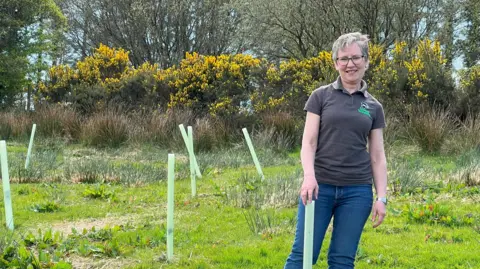
Rosemary Mulholland, Head of Nature Recovery with Ulster Wildlife, is part of the team that has embarked on an ambitious 100-year restoration programme to restore temperate rainforests.
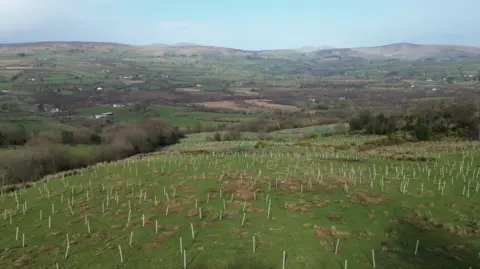
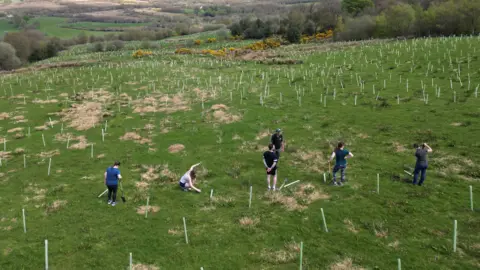
Almost 30,000 native trees of Irish provenance, such as oak, alder and rowan, have been planted on the 41-acre site which is situated at Lenamore Wood, near Gortin in Omagh.
The first trees were planted in February and March 2026.
The project is is an expensive one, with partnership from Aviva who has committed around £38 million.
It will take about a year before we see the tips of the trees sprouting through the plastic tubes, however, it will be at least 100 years before the trees are properly grown.
When asked how she feels about never seeing the project fully finished, she said: "It is sad, but in a way it's a great privilege, isn't it, to just be able to take this land and turn it into a habitat that is now largely lost."

What is a temperate rainforest?
John Martin who is the director of the Woodland Trust in Northern Ireland said temperate rainforests are "usually characterised by native tree species such as oak, birch, alder and hazel".
"They've lots of humidity supporting mosses, lichens, and complex woodland structures, including ravines, rivers and rocky outcrops."
He said they occur in areas of high rainfall, mild temperatures and a strong ocean influence.
"They deliver critical environmental services, including biodiversity protection, so essentially nature protection and carbon storage."
How have these natural habitat's become so endangered?
Martin explained that these rainforests have been around for centuries.
"If you go back, following the last ice age, as the climate warmed, trees gradually colonised Ireland and then by around 8,000 to 9,000 years ago, most of the island was probably covered in dense woodland."
He said these forests were dominated by oak, hazel, elm, birch and pine but would have functioned as what we now recognise as a temperate rainforest in the wetter west.
Martin said that in very broad terms, between 6,000 to 3,000 years ago, as Ireland began to be colonised more, Neolithic farmers would have began to clear land for crops and grazing and over time, different towns and settlements began to spring up which would have prevented regeneration.
"Most likely, the largest scale losses were probably in the 16th to 19th century, which saw the kind of critical collapse phase of Ireland's rainforest," he said.
 Eoghan Daltun
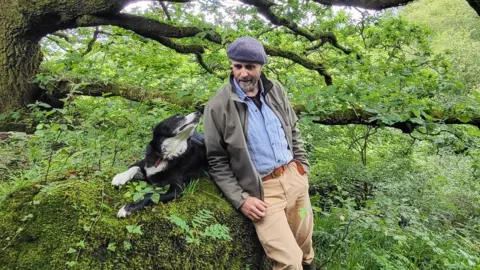
Eoghan Daltun has been rewilding his own farm and restoring temperate rainforests privately for the past 17 years.
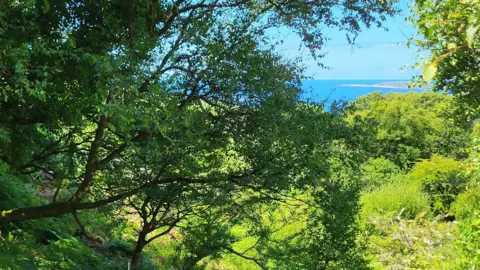
Daltun is based on the Beara Peninsula in west Cork and his 73 acre farm overlooks the Atlantic ocean and the Skellig Islands.
Originally from Dublin, he sold his house in 2009 and has been rewilding his farm in Cork ever since.
"I just wanted a life that was closer to nature for myself and my two sons," he said.
His restorative work began due to his farm being severely ecologically damaged.
This was as a result of feral goats who ate every tree seedling which then prevented the forest from regenerating.
 Eoghan Daltun
'We're threatening our own future survival'
Daltun explained just how important these rainforests are, "whether we realise it or not, we depend totally on natural ecosystems for our very survival".
"By removing them and repressing their return, we're threatening our own future survival," he said.
He added that it has become his life's work to restore the rainforest and to showcase what could be and what once was.
"I place this in a context of catastrophic global nature loss and ecosystem erasure, which I think is one of the worst things happening right now globally.
"The worst threat to the biosphere is global nature loss, but also to humanity."
 Ulster Wildlife
Mulholland from Ulster Wildlife said as the project at Lenamore Wood develops, they will be monitoring the progress on site.
"We'll have fixed point photography. So you'll be able to come and put your phone on a little phone cradle, read the QR code and send your photograph off so that we will have an ongoing, photographic record of how it's changing."
She said there will also be bird and butterfly surveys done, as well as moth trapping and remote sensors for bats, as it's important to see what other animals come out at night too.
Mulholland said that this project is so important for climate change, "the trees capture carbon, they help with flood risks and they allow our ecosystems to thrive".
In the future, she is hopeful for more projects like this one and says they are on the lookout for some more land.
A car park will come in due course but the site will be opened to the public soon to come and have a walk, connect with nature and to see how the trees develop over time.
Even if it takes a couple hundred years, this site will be for generations to enjoy.