ROME (AP) — The head of Latin America’s top development bank made a pitch to Pope Leo XIV this week in the face of the Vatican’s call to divest from the mining industry: that the mistakes of the past can be avoided in extracting rare earth minerals to supply a global tech boom.
Ilan Goldfajn, head of the Inter-American Development Bank, met privately with the pope on Friday and asserted the potential of rare earth mining, saying it could be a boon to Latin America provided there are safeguards and value is added locally.
It’s probably not an easy sell. The Vatican for years has taken a firm stand against multinational mining corporations, especially in Latin America and in favor of the Indigenous peoples, whose lands and livelihoods are often ravaged when mining projects come to town.
Goldfajn’s visit, which followed one earlier this year by mining executives, suggests that he recognizes the weight of the pope’s words in the majority-Catholic region, and a desire to sensitize him to the possibility of a better way of doing business. Whether Leo can be swayed is another matter, given his own experience in the region and criticism of the often corrupt deals mining companies ink with governments in the developing world.
Pope Leo XIV celebrates the funeral service for late Cardinal Camillo Ruini, in St.Peter’s Basilica at the Vatican, Thursday, June 18, 2026. (AP Photo/Andrew Medichini)
Pope Leo XIV celebrates the funeral service for late Cardinal Camillo Ruini, in St.Peter’s Basilica at the Vatican, Thursday, June 18, 2026. (AP Photo/Andrew Medichini)
Countries have identified dozens of minerals, including copper, cobalt, lithium and nickel, as critical because they are essential for new technologies. The 17 rare earth elements are a subset of them. They’re used in a wide range of products, including smartphones, semiconductors, electric vehicles and jet engines.
“It’s a unique opportunity for the region, but you need to do it in the right way with the standards, the labor conditions, with the environmental conditions, the governance,” Goldfajn said in an interview in Rome on June 18, one day before his meeting.
“We have exactly the tools to do that,” he added, noting the IADB has a roughly $4 billion pipeline of critical mineral projects in the region, mostly in Chile, Argentina and Brazil, and three-quarters of that amount with private companies. He had just delivered a presentation on rare earth minerals at a finance conference, with an eye on potential European investors.
A pope who knows Peru
Mining has a checkered, centuries-long history in Latin America, from forced labor and displacement of Indigenous peoples to deforestation, poisoning of waterways and deadly dam collapses. Foreign companies withdrew much of the wealth from the earth without enriching local populations. In colonial times, silver and gold made its way across the ocean to adorn Catholic churches.
Leo, who spent two decades working as a missionary in Peru, would be intimately familiar with the plight of Indigenous peoples in mining areas and the environmental impact of extraction industries on the land. He ministered in Chulucanas, in the archdiocese of Piura, which has huge copper mining projects, and in Trujillo, known for its gold deposits. His final Peruvian posting, Chiclayo, is a big logistical hub for northern Peru’s extraction industries.
Sign up for Morning Wire: Our flagship newsletter breaks down the biggest headlines of the day.
“He must have seen both sides: the promise, the future, but also the challenges,” Goldfajn said of Leo’s time in Peru. He noted that Leo held a private audience with a group of top mining executives in January, which he heard from them had been “very constructive.”
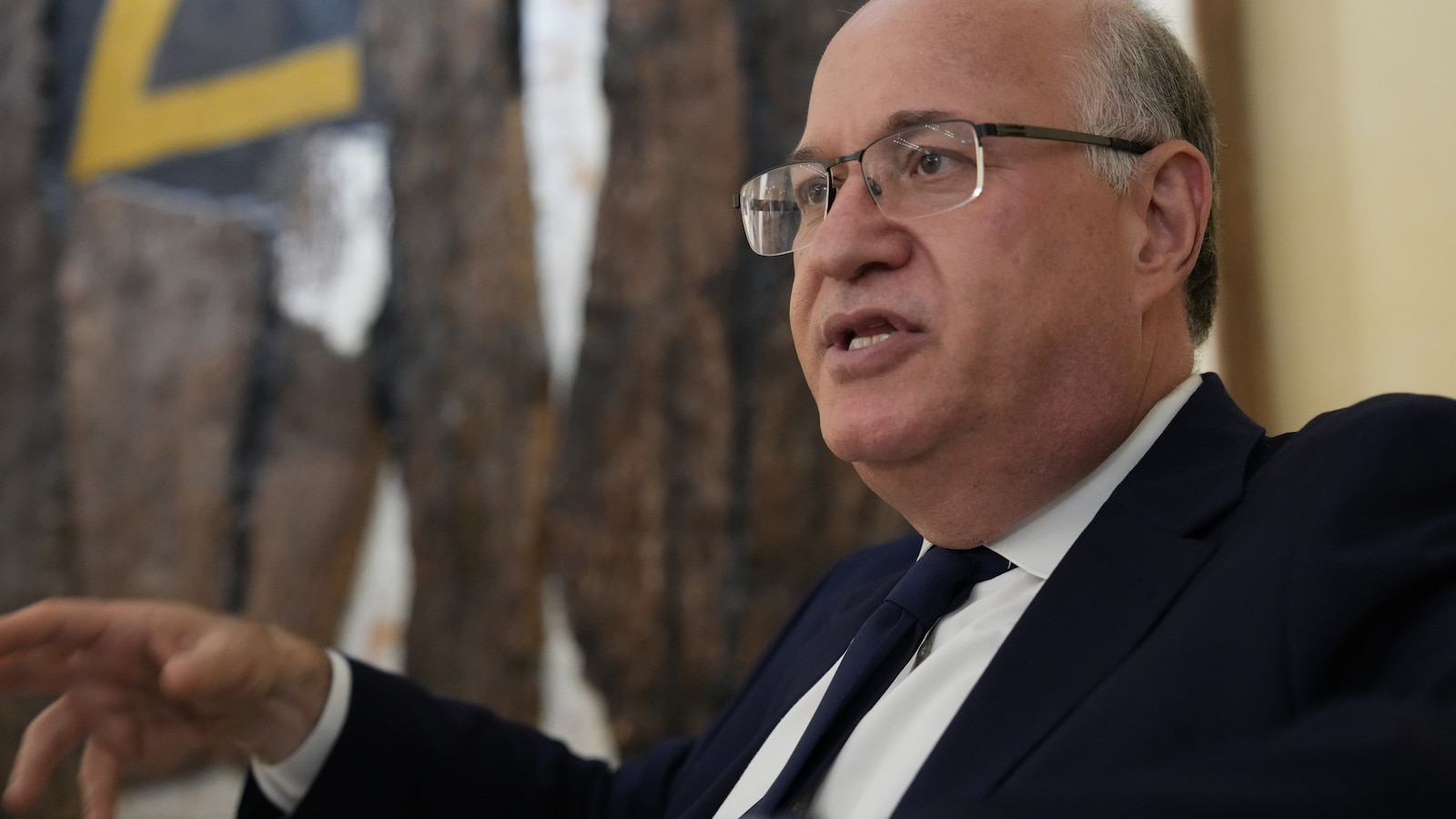
The President of the Inter-American Development Bank Ilan Goldfajn speaks to the Associated Press during an interview in Rome, Thursday, June 18, 2026. (AP Photo/Domenico Stinellis)
The President of the Inter-American Development Bank Ilan Goldfajn speaks to the Associated Press during an interview in Rome, Thursday, June 18, 2026. (AP Photo/Domenico Stinellis)
But two months later, the Vatican launched a campaign to encourage divestment from mining companies. At a Vatican news conference, top officials held up an ecumenical Christian network, known as the Church and Mining Network, that is active in particular in Latin America. The campaign seeks to encourage local churches to review their investment strategies and divest where needed, and to share information especially with Indigenous groups about the types of extraction occurring on their lands.
Leo is expected to visit Peru in November, including places where he ministered. In each of the three sub-Saharan countries he visited during his April trip to Africa — Cameroon, Angola and Equatorial Guinea — he blasted the “colonization” of Africa’s minerals by mining companies.
It makes sense for people like Goldfajn to try to engage Leo, even if the pope alone won’t move investment decisions, Bryan Harris, managing partner at Sabio, a Latin America-focused strategic advisory firm, wrote in an email.
“The decades he spent in Peru give him personal credibility and his messaging on mining sets the tone for how dioceses and parishes across the continent will engage with mining companies and projects,” said Harris, who consults for international mining companies in the region. “These groups are often the basis of local opposition movements to mining, so the Pope has considerable sway on whether relations are confrontational or conciliatory.”
A mine operated by Serra Verde Mining in Minacu, Goias state, Brazil, Monday, July 28, 2025, produces rare earth elements, including neodymium, praseodymium, terbium and dysprosium which are essential for the production of permanent magnets. (AP Photo/Eraldo Peres, File)
A mine operated by Serra Verde Mining in Minacu, Goias state, Brazil, Monday, July 28, 2025, produces rare earth elements, including neodymium, praseodymium, terbium and dysprosium which are essential for the production of permanent magnets. (AP Photo/Eraldo Peres, File)
Harris noted that processing of rare earths can be extremely dirty, involving heavy chemical use that can contaminate water resources without close monitoring of companies’ sustainability commitments and enforcement by federal regulators.
Mining as colonization in modern day
Leo’s predecessor, Pope Francis, a native of Argentina, singled out the toll of mining in his 2015 environmental encyclical “Praised Be,” noting the pollution of underground water systems as a result of runoff, the mercury pollution in gold mining or sulfur dioxide pollution in copper mining.
Francis said it was “essential” for Indigenous communities to be the principal dialogue partners when large projects affecting their land are being considered.
The Vatican didn’t provide any readout of Leo’s private audience with Goldfajn. In a separate audience Friday, Leo met with participants in a conference at the Vatican’s environmental educational center named for Francis’ 2015 encyclical. He denounced the profit-at-all cost mentality of those who seek to plunder the earth “at the expense of the most vulnerable and enhances the risk of dehumanization.”
There are 75 million tons (82.7 million U.S. tons) of rare earth oxides around the world, more than half in China, and with Brazil home to the second-largest reserves, according to the U.S. Geological Survey’s most recent estimate.