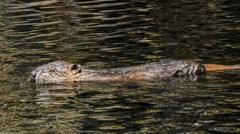
Beavers, often described as "ecosystem engineers", were once widespread in Britain but were hunted to extinction about 400 years ago.
In 2015, the semi-aquatic mammals were reintroduced to the wild in the River Otter, Devon, and in February this year four pairs were released to Par and Fowey rivers in Cornwall.
Puttock said: "One of the biggest modifications beavers do is build dams… that creates these really complex wetlands, which for beavers provides them with safety from predators and ability to move around in the landscape.
"Increasingly, our research has shown this provides benefits to us as people and society, building a more resilient landscape."
He said when the landscape holds more water, it built resilience for both flooding and dry periods.
The slow release of water creates both habitat refuge and water resilience, he added.
Puttock said wetland ponds held about 1,000 cubic metres of water each, reducing peak flows by 30% by retaining it in leaky dams.
"One beaver wetland won't solve all of our drought problems," he said.
"But overall, as beavers expand in our landscapes, and also as we do other nature-based solutions or wetland creation schemes... it does mean that we are less prone to droughts."
Puttock said when he started researching beavers a decade ago he was not thinking about wildfires but flood management.
"We're famously a wet country but there's been a whole raft of really positive research coming out of the States that's basically working on the premise that water doesn't burn," he said.
"When we can create wetlands and beaver wetlands, it creates resilient landscapes to drought but also to the extremes of drought such as wildfires.
"Having these wet landscapes can provide that firebreak."
Follow BBC Devon on X, external, Facebook, external and Instagram, external. Send your story ideas to spotlight@bbc.co.uk, external.