There are many reasons why it might not work.
At the same time, it is potentially a rare chink of light in a bleak picture. Hamas has never agreed to disarm before now. Handled carefully and well, there is a chance now to make diplomatic progress.
A bargain lies at the heart of the new proposition for Hamas to disarm in Gaza.
The idea is that as Hamas hands over its weapons, Israel pulls out of the 70% of Gaza that it occupies.
That may sound simple, but the realities of politics, war, zero trust, the deaths of thousands and the destruction of Gaza make the process very complicated.
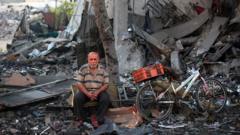
Life in Gaza is catastrophic for well over 2 million Palestinian civilians who are living in desperate conditions.
For most, Israel has destroyed their homes and their livelihoods. Israel killed more than 70,000 Palestinians during the war, and more than 1,000 more since the ceasefire, according to the Hamas-run health ministry whose figures are seen as reliable by the UN. Unicef says that Israel has killed more than 20,000 children since 7 October 2023, with at least 1,000 babies among the dead and wounded.
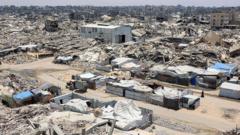
Much of Gaza is rubble. It is not just the damage caused by Israel Defense Forces (IDF) military operations. There has also been an organised, officially sponsored project to destroy communities and smash infrastructure. Civilian demolition contractors from Israel have been contracted to finish the job started by IDF bombs.
Many Palestinians believe Israel wants to force them out, by making life so insupportable and appalling that they will leave if they get the chance. Leaders and senior officials inside Jordan and Egypt also believe that powerful individuals in the Israeli government are working to create the conditions for the ethnic cleansing of Palestinians, most likely across their borders.
On the Israeli side, there is a strong sense in the Jewish majority of 80% or so that Hamas will remain a potentially deadly threat until it is totally disarmed and stripped of any vestige of power.
On 7 October 2023 Hamas and other Palestinians attacked Israel, killing almost 1,200 people, around two thirds of whom were civilians including children, and taking 251 people into Gaza as hostages. Many Israelis believe Hamas would do that again if it had the chance.
The diplomatic process that produced the agreement with Hamas does not operate in a bubble. Making the plan work depends on broader issues too.
Israel has a general election at the end of October. Prime Minister Benjamin Netanyahu is behind in the polls and fighting not just for his political life and legacy but potentially for his liberty. While he remains in office, his long running trial on corruption charges that could carry a jail sentence has been slowed to a crawl. That would change if he lost power.
Netanyahu faces pressure at home and abroad. Domestically he does not want his political opponents to be able to accuse him of being soft on Hamas. Internationally the only address that matters to him is in Washington DC.
The US also has elections looming with midterms in November. President Donald Trump cannot a win in the war on Iran, so he needs one in Gaza. If Trump's Republican party loses badly, the power he relishes using will drain away. Trump will blame Netanyahu if he decides he is preventing the victory he wants and needs.
One of Netanyahu's boasts to Israel's electorate is that he can handle the Americans, including Trump, better than any of his rivals. A Trump tirade before election day in Israel scuppers that proposition.
Netanyahu is an expert at playing for time when faced with a big challenge. He will try to juggle pressure at home and pressure from the Oval Office until election day.
Hamas is also under severe pressure. Most of its senior men and thousands of its fighters were killed by Israel. The IDF still assassinates senior Hamas figures when it gets a chance. As I write, a flash from the IDF on my phone says it has killed a commander of a Palestinian militia who it says took hostages on 7 October 2023.
Many Palestinians blame Hamas for the consequences of its decision to attack Israel on 7 October. Hamas also faces challenges from powerful families and by militias funded and backed by Israel.
It is trying to rebuild grass roots support. This was how the BBC's Gaza correspondent Rushdi Abu Alouf put it to me: "For months, Hamas increasingly shifted part of its focus back to social and political outreach, expanding Quran memorisation programmes and charitable activities aimed at children, teenagers and young people, while taking advantage of the severe humanitarian crisis and the growing dependence of so many families on aid."
Khalil al Hayya, the newly confirmed political leader of Hamas, was a crucial player in the decision to drop objections to the framework. Egypt and Turkey did much of the hard diplomatic work to get him there.
Hamas concessions are linked to Israel agreeing to pull back in Gaza. Israel is on record as demanding full Hamas disarmament as a pre-condition for withdrawal.
Only a step-by-step agreement, starting small and building confidence, has a chance of working. Trump will have to stay engaged, which is far from certain with a war with Iran among a planet full of other challenges.
Just keeping the process going will require sustained diplomatic engagement and no sudden shocks that make meditation impossible.
That will be difficult. The occupied West Bank is on the verge of an explosion of even worse violence. Figures gathered by ACLED, a group that monitors armed conflict, says that 2026 is on track to become the most violent year in the West Bank since it began monitoring the territory a decade ago.
Jewish settlers have been allowed by the IDF and encouraged by extremists in the Netanyahu government to run riot, attacking and sometimes killing Palestinians and driving them off their land.
Palestinians have been organising themselves to resist. Some opponents and critics of Netanyahu believe that he wants a major crisis on the West Bank to justify a tough response before the elections and remove any pressure to pull back in Gaza.
Netanyahu and prominent ministers in his cabinet have said repeatedly that there will never be a Palestinian state.
Bezalel Smotrich, the finance minister, is committing the government to decisions aimed at increasing Jewish settlement and killing off the prospects of an independent Palestine. Smotrich is an extreme religious nationalist who has been sanctioned by major Western countries and banned from entering the UK, France, other leading European nations, as well as Australia and New Zealand. Israel condemned those decisions as antisemitic.
A process that does not give Palestinians a political horizon and a route to self-determination will not work, condemning another generation to lives dominated by war.
Diplomatic failure would not benefit Palestinians or Israelis. It would play into the hands of those on both sides who believe their conflict has no solution other than defeating their enemy.