NEWYou can now listen to Fox News articles!
China, Russia, Iran and North Korea are acting as a strategically aligned bloc even without a formal mutual-defense treaty, according to a new Foundation for Defense of Democracies book warning that their cooperation could leave the United States confronting multiple crises simultaneously.
The book, "Axis of Aggressors: Countering the Cooperation of China, Russia, Iran and North Korea," examines how the four authoritarian governments support one another across military, economic, cyber and technology domains.
Its authors acknowledge that the grouping is not a NATO-style alliance. It has no unified command, comprehensive defense commitment or complete trust among its members. But they argue that its practical effects are already visible in active conflicts.
TRUMP TO CONFRONT XI AT HIGH-STAKES SUMMIT OVER CHINA BACKING FOR IRAN, RUSSIA
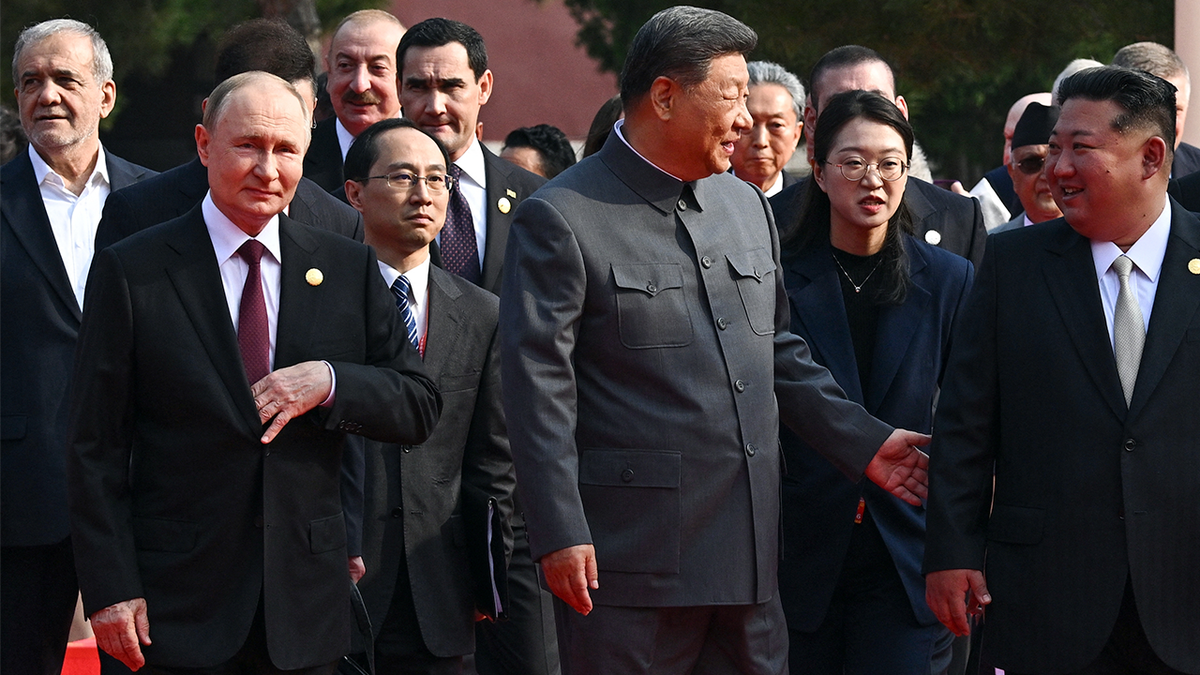
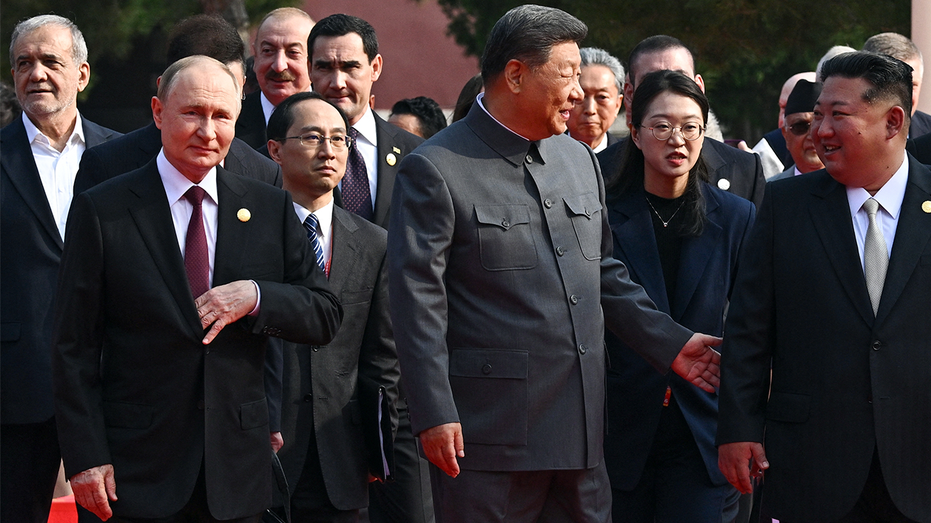
In this pool photograph distributed by the Russian state agency Sputnik, Russia’s President Vladimir Putin, China’s President Xi Jinping and North Korea’s leader Kim Jong Un walk before a military parade marking the 80th anniversary of victory over Japan and the end of World War II in Beijing’s Tiananmen Square on Sept. 3, 2025. Iranian President Masoud Pezeshkian is seen at left in the background. (Sergey Bobylev / POOL / AFP via Getty Images)
"I just got back from a couple of weeks in Ukraine, and when I’m sitting in Ukraine, it’s really obvious to me that Ukraine is fighting Russia, North Korea, Iran and China," retired Rear Adm. Mark Montgomery, one of the book’s three authors, told Fox News Digital.
Montgomery pointed to North Korean ammunition and troops, Iranian drones and production expertise, and Chinese economic and technological support for Moscow.
"China is backstopping the whole thing, providing the economic backstop to Russia’s economy so they can survive this four-year catastrophic event for Russia," Montgomery said. "They’re providing microelectronics that we see in ballistic, cruise and hypersonic missiles."
The book’s researchers documented 616 instances of security cooperation among the four governments from Jan. 1, 2019, through Dec. 31, 2025, including arms transfers, weapons development, military exercises, intelligence sharing and military exchanges.
A ‘simultaneity problem’ for the U.S.
The central danger, Montgomery said, is what the book calls the "simultaneity problem."
"We don’t get to handle these with a singularity anymore. We have to handle this with a simultaneity," he said. "And I don’t think we can handle two problems at once, much less three or four."
During a potential confrontation between China and Taiwan, Montgomery said, North Korea could threaten South Korea or conduct limited attacks intended to pin down U.S. forces. A conflict involving Russia and NATO’s Baltic members could be accompanied by Iranian terrorism or other hostile activity.
THREE KEY REASONS WHY AMERICA CANNOT AFFORD TO LOSE TAIWAN TO COMMUNIST CHINA
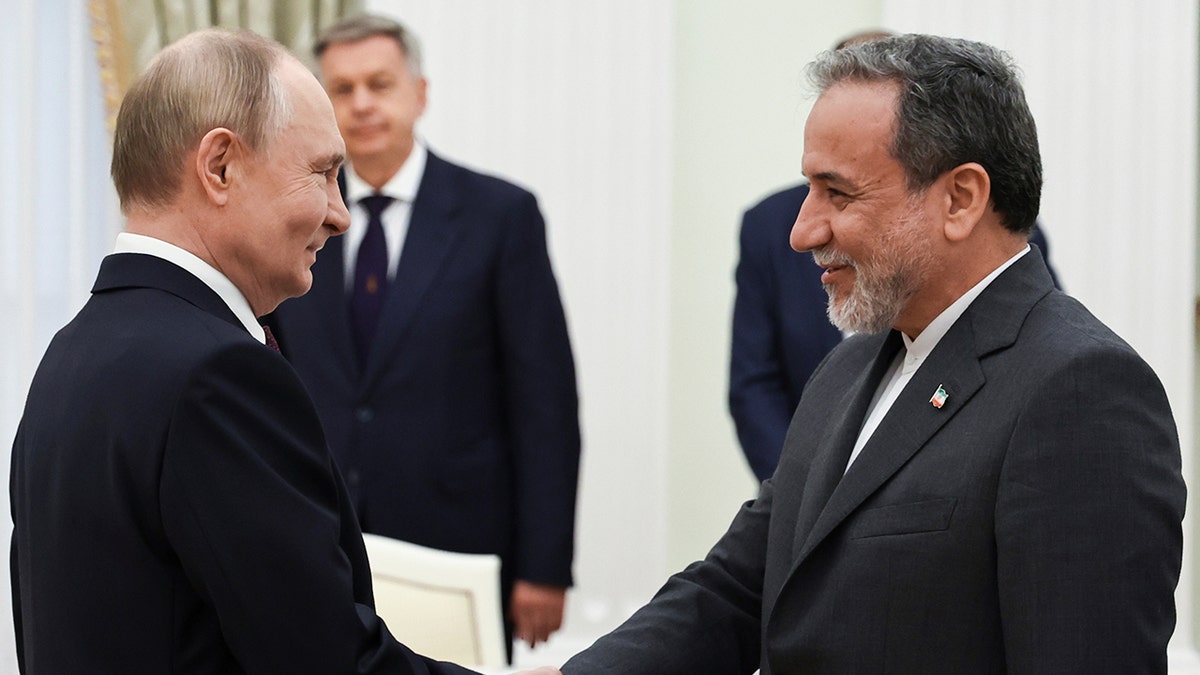
Russian President Vladimir Putin, left, greets Iranian Foreign Minister Abbas Araghchi prior to their talks at the Kremlin in Moscow, Russia, Monday, June 23, 2025. (Alexander Kazakov, Sputnik, Kremlin Pool Photo via AP)
The book identifies China-Russia military cooperation as the axis’s most consequential bilateral relationship. Chinese dual-use products have helped sustain Russia’s defense industrial base, while Moscow is transferring technology and battlefield lessons that could assist China in a Pacific conflict.
North Korea has supplied Russia with millions of artillery rounds, ballistic missiles and troops, while Moscow has assisted Pyongyang’s missile, space, drone and nuclear programs, according to the book.
Iran has provided Russia with drones and production knowledge. The book warns that Russian and Chinese assistance could also help Tehran rebuild military capabilities damaged during its conflicts with Israel and the United States.
"The longer they can entangle the United States, whether it was in Ukraine or in Iran, China and Russia are the primary beneficiaries," Montgomery said.
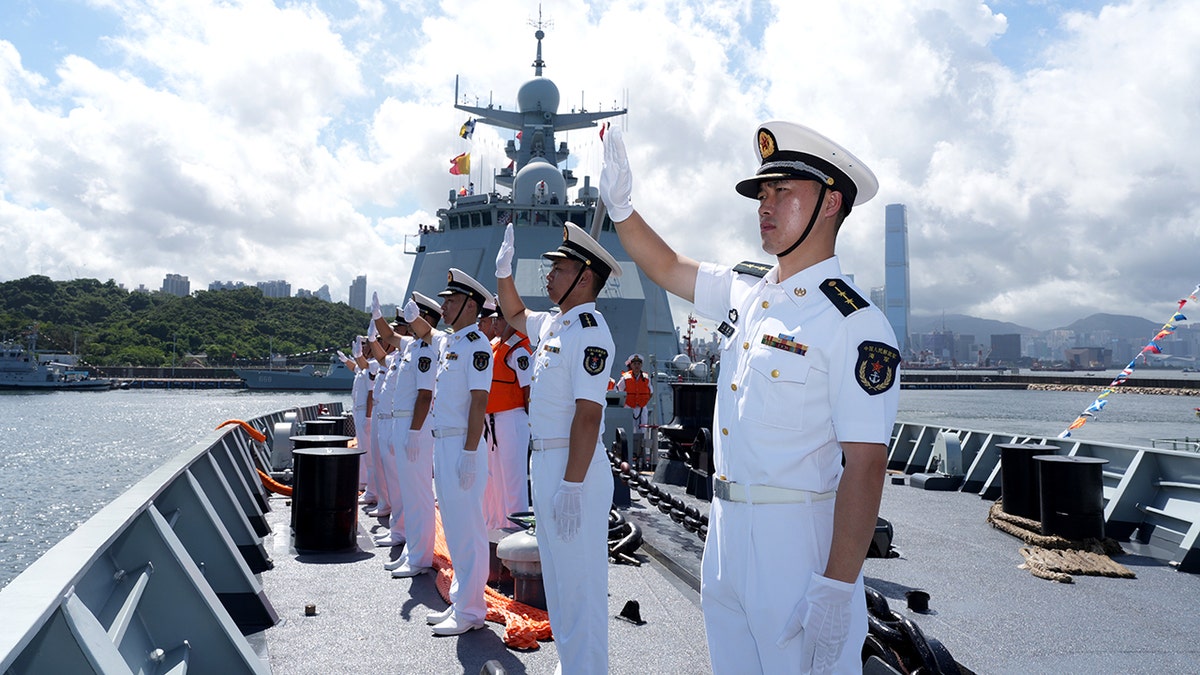
Officers and soldiers on the Chinese People's Liberation Army PLA Navy's guided-missile destroyer Nanning wave as the ship enters the waters of the Hong Kong Special Administrative Region in south China, July 2, 2026. (Ji Peng/Xinhua via Getty Images)
China bankrolls the axis
Economic ties underpin the military cooperation, according to co-author Elaine Dezenski, who described the four-country economy as a "fractured alignment."
"These four players are bound together more by necessity than they are by a specific trust or shared strategy among them," Dezenski told Fox News Digital. "China needs energy. Russia and Iran need buyers for their oil and gas. And North Korea needs any lifeline that it can get."
China purchases discounted Russian and Iranian energy while providing goods, technology and access to its domestic market.
The relationships remain unequal. Russia and Iran compete to sell similar products, while China can seek other suppliers. But Dezenski said those divisions should not obscure the benefits the cooperation provides.
"The economics of this very much underpin the foundations for the military engagement that we see," she said.
The book says China purchases as much as 95% of Iran’s oil exports. Some sanctioned oil is routed through third countries, relabeled or processed by independent Chinese refineries known as "teapots."
"The export juggernaut that is China today is fueled by sanctioned oil and gas," Dezenski said.
TRUMP MAY CLAIM HE WON THE FIGHT WITH IRAN, BUT THERE’S A BIGGER WAR ALREADY UNDERWAY
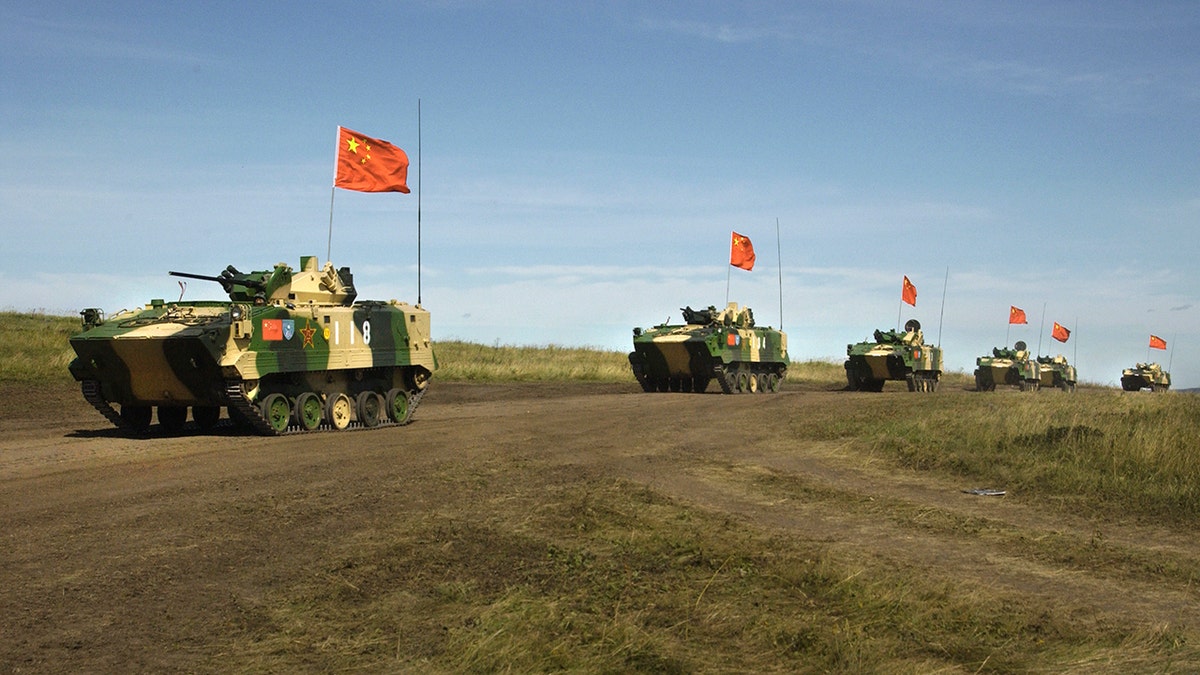
FILE - In this Aug. 13, 2007, file photo, a convoy of Chinese APCs roll by during a rehearsal for a massive joint military exercise by the two former Cold War rivals, the first on Russia's territory in the Chelyabinsk region in Russia's Ural Mountains. Chinese and Russian military forces are engaged in joint exercises through Friday, Aug. 13, 2021, in northwestern China as ties grow between the two autocratic states amid uncertainty over instability in Afghanistan. (AP Photo, File)
New payment networks challenge U.S. leverage
Dezenski also warned that China, Russia and Iran are developing payment systems outside traditional Western banking infrastructure. More trade is being settled in yuan through China’s Cross-Border Interbank Payment System, or CIPS, potentially reducing Washington’s ability to enforce sanctions through the dollar system.
"We need to really think about that sooner rather than later, before this alternative payment system becomes too big to tackle," Dezenski said.
Cyber ties blur the state-criminal line
Montgomery said the line between criminal hackers and government operatives is often deliberately blurred in all four countries.
"These regimes routinely outsource work to criminal groups to keep their own hands clean, and those groups are increasingly networking with each other," he said.
The book cites ties involving Iranian cybercriminals and Russian ransomware groups, Chinese actors on Russian dark-web forums, and Russian and North Korean state-backed hackers using shared operational infrastructure.
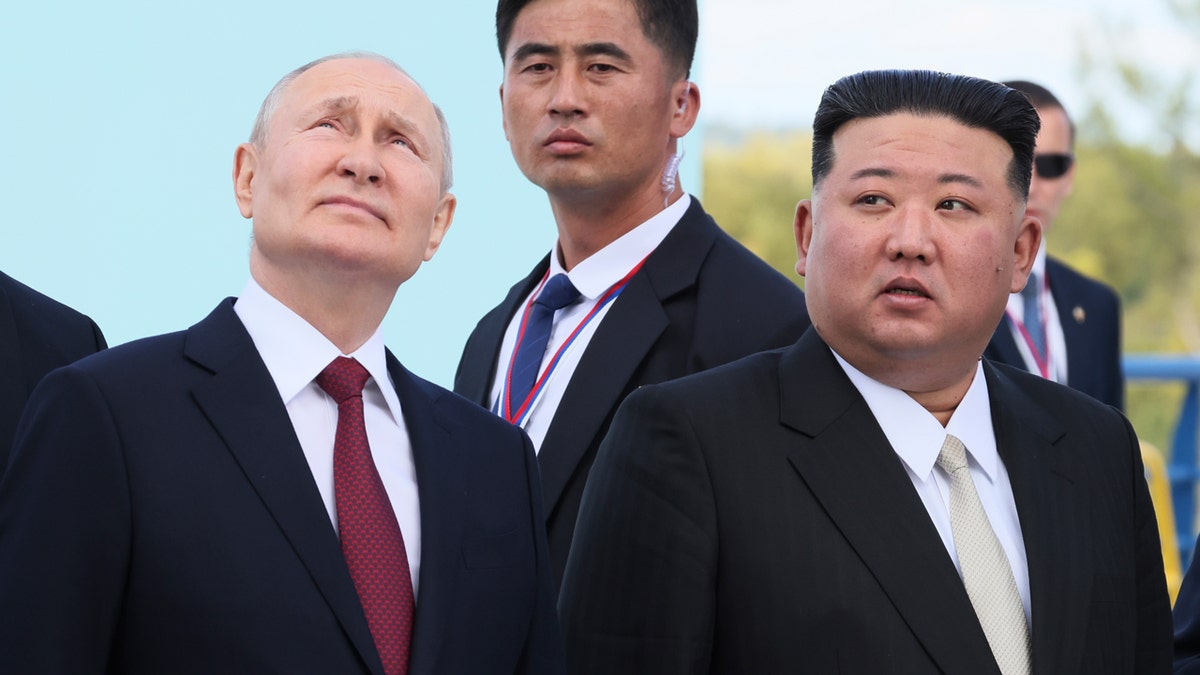
Russian President Vladimir Putin, left, and North Korea's leader Kim Jong Un, right, examine a launch pad of Soyuz rockets during their meeting at the Vostochny cosmodrome outside the city of Tsiolkovsky, about 125 miles from the city of Blagoveshchensk in the far eastern Amur region of Russia, on Sept. 13, 2023. North Korean leader Kim hailed the country's relationship with Russia on June 12, 2024, as reports suggest that Russian President Putin will soon visit the isolated country for his third meeting with Kim. (Mikhail Metzel, Sputnik, Kremlin Pool Photo via AP, File)
Outside experts see an integrated threat
Carrie Filipetti, executive director of the Vandenberg Coalition and a former State Department official during the first Trump administration, said drone warfare demonstrates how assistance moves among the countries.
"Chinese components are used to create Iranian drones, which are then deployed by the Russians against Ukrainian civilians," Filipetti told Fox News Digital.
She said the relationship has also endangered American troops, pointing to the January 2024 Tower 22 attack in Jordan, which killed three U.S. Army Reserve soldiers and wounded more than 40 service members.
"The military and ideological relationship between Russia and Iran is not just a theoretical threat to the United States — American service members have been killed as a result of it," Filipetti said.
Filipetti said the attack used an Iranian drone and Russian tactics developed during the war in Ukraine. "These adversaries don’t agree on everything, but they do on one thing: to reorient the world away from America and the West," she said. "Our service members and citizens will continue to suffer until we treat the threat as the united threat it is."
Retired Air Force Lt. Gen. Richard Newton said the danger stems not only from military modernization in each country, but from the degree to which the four governments are increasingly coordinating.
"I couldn’t agree more with the underlying findings the authors present regarding the rapid military modernization unfolding across multiple domains — air, sea, land, space and cyber — emanating from China, Russia, Iran and North Korea," Newton told Fox News Digital.
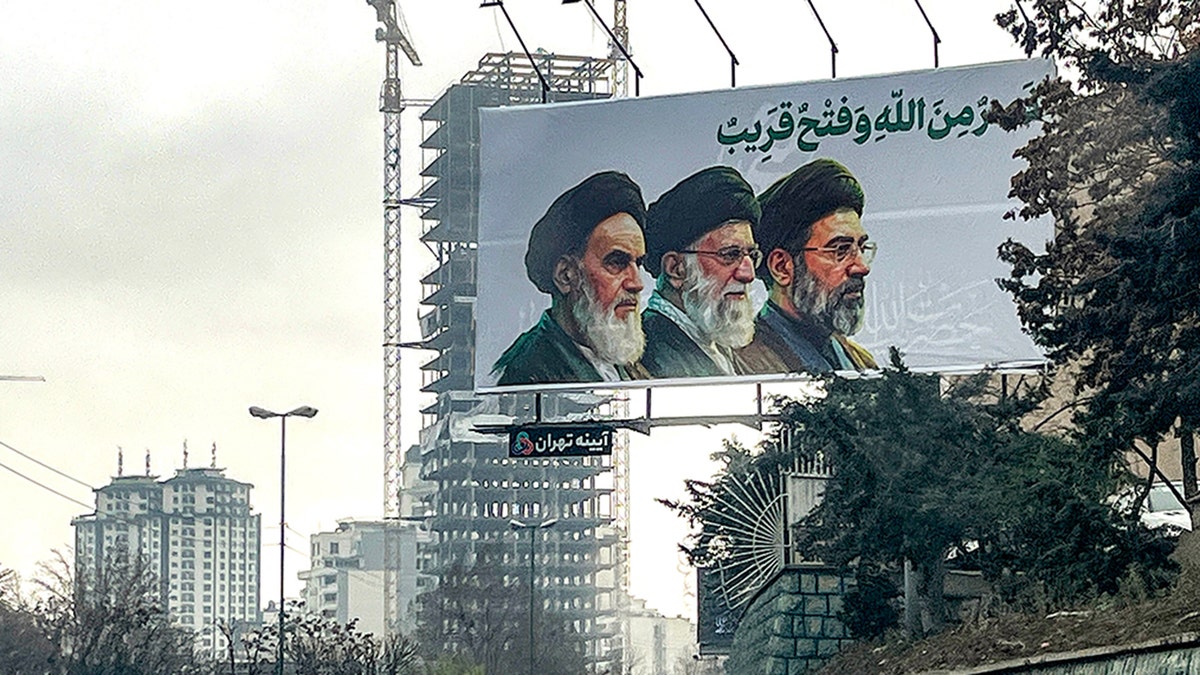
A billboard depicting Iran's supreme leaders since 1979: (L to R) Ayatollahs Ruhollah Khomeini (until 1989), Ali Khamenei (until 2026), and Mojtaba Khamenei (incumbent) is displayed above a highway in Tehran on March 10, 2026. Iran marked the appointment of Ayatollah Mojtaba Khamenei to replace his father as its supreme leader on March 9, 2026. (AFP/Via Getty Images)
"These nation-states represent extraordinary adversarial challenges for the United States. That’s concerning enough," he said. "But a major challenge President Trump is facing in his second administration is the level and degree of integration, synchronization and coordination among these four adversaries, who are more unified today than ever in their collective pursuits to threaten U.S. national security interests."
Newton said the changing character of warfare, demonstrated by more than four years of fighting between Russia and Ukraine and the current U.S.-Iran conflict, has compounded the threat.
"Couple that with the changing nature of warfare we’ve been witnessing," he said, "and the task to defend our nation is now much more complex and daunting."
Retired Air Force Gen. Philip Breedlove, who served as NATO supreme allied commander and commander of U.S. European Command from 2013 to 2016, argued that Washington’s language understates the severity of the confrontation.
"We often say that we are in ‘strategic competition’ with China and Russia. They are at war with us," Breedlove told Fox News Digital.
Breedlove said China, Russia, Iran and North Korea "are not partners looking for cooperation with the U.S.," but governments seeking to "diminish and defeat" American power.
"The enemy gets a vote," Breedlove said. "Our enemies are voting by their support to Russia and Iran."
He added that assistance from the other countries has become increasingly important to Moscow as it struggles to sustain its war.
"Aid is critical to Russia," Breedlove said. "Russia is failing and becoming ever more dependent on its allies."
The authors recommend stronger coordination with allies, expanded defense production, greater protection of U.S. critical infrastructure and more aggressive sanctions enforcement.
CLICK HERE TO DOWNLOAD THE FOX NEWS APP

The war in Iran has pushed China and Russia closer together. FILE: Xi Jinping, left, Vladimir Putin, right (Sergei Guneev/Reuters)
Dezenski called for targeting the full network supporting sanctioned Russian and Iranian oil, including refineries, ports, insurers and financiers, rather than focusing primarily on individual vessels.
"We need to treat this axis as a threat, as a combined threat," Montgomery said, "that will confront us in every one of our crisis areas."
Efrat (Effie) Lachter is an investigative journalist, filmmaker and war correspondent. She has directed and produced over 200 documentary segments across more than 40 countries. Recipient of the 2022 Peres Center for Peace Award, Lachter is also a 2023-24 Knight-Wallace Journalism Fellow at the University of Michigan. She holds a bachelor's degree in communication and a master's degree in political science.
