Koh Eweand Jake Kwon,Seoul correspondent

 POOL / AFP via Getty Images
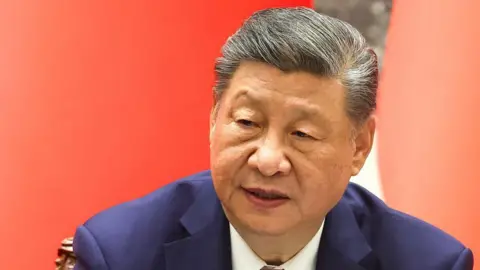
China's leader Xi Jinping is visiting long-standing ally North Korea for the first time in nearly seven years, state media report.
Xi will be in North Korea from 8-9 June at the invitation of his counterpart Kim Jong Un. Xi last visited Pyongyang in 2019.
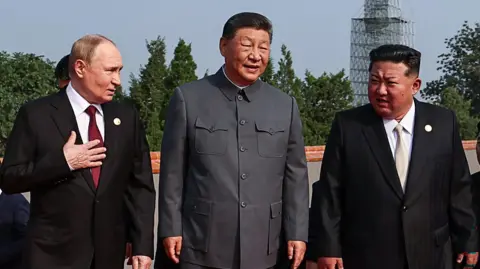
The visit comes weeks after Xi received US President Donald Trump and Russian President Vladimir Putin in Beijing - two countries that loom large over Pyongyang's foreign policy.
China is a key economic and political partner of North Korea, which faces sweeping international sanctions as a result of its nuclear weapons programme and alleged human rights violations.
Pyongyang views the US as its main political enemy, and Russia as a growing friend to whom Kim has pledged unwavering support.
Xi is wary of the burgeoning alliance between Kim and Putin, despite Beijing's close ties with both Pyongyang and Moscow.
China and North Korea share a 1,400km-long border and are bound by a defence pact - the only one China has with any country. It guarantees mutual support if either is attacked.
This year marks the 65th anniversary of that treaty.
Beijing has also long served as the main mediator between Kim's pariah regime and the rest of the world.
 Getty Images
For Kim, the propaganda value of Xi's visit is self-evident. North Korea had improved his standing on the world stage after withstanding the pandemic and entering the war in Ukraine on the side of Russia.
Kim has been proudly displaying his nuclear and missile arsenal. He has also been developing capital Pyongyang to visiting dignitaries. And he wants the world to know that it was all achieved without bending his knee to the US or engaging with the South.
Pyongyang now has the leverage to demand a larger exchange with China. It is widely expected that Kim will seek more trade over the land border and more Chinese tourists to fill its newly built beach and ski resorts.
Seoul is hoping Xi will play a mediator in this trip, nudging Pyongyang to resume dialogue with both Seoul and Washington.
Since Kim declared the end to reunification efforts with the South in December 2024, he had called South Koreans a sworn enemy and had cut all levels of communication with Seoul.
When the North Korean women's professional football team visited South Korea last month to face a South Korean football team, the freeze-out was in full display.
The North Koreans barely acknowledged the South Korean public who showed up to welcomed them at the airport and the stadium. They coldly shook hands with the South Korean players before the match then followed with rough and aggressive play.
South Korea's minister of unification Chung Dong-young said he believes Xi will discuss resuming the US-North Korea talks with Kim.
While Beijing is a long-standing promoter of denuclearisation of the Korean Peninsula, echoing international calls for North Korea's disarmament, it has significantly toned down this position in recent years.
During the Trump-Xi meeting last month, the two leaders reaffirmed the shared goal of denuclearising North Korea, according to a White House fact sheet of the meeting.
But when asked about this at a press briefing, a Chinese foreign ministry spokesperson did not directly confirm the agreement, instead saying China's position on the issue has maintained "continuity and consistency".
Pyongyang, for its part, has made it clear that it will not steer away from its nuclear ambitions.
Just this week, Kim said North Korea's "weapons-grade nuclear materials production capacity more than doubled" in the past five years, as he toured a new nuclear facility, state media reported.