
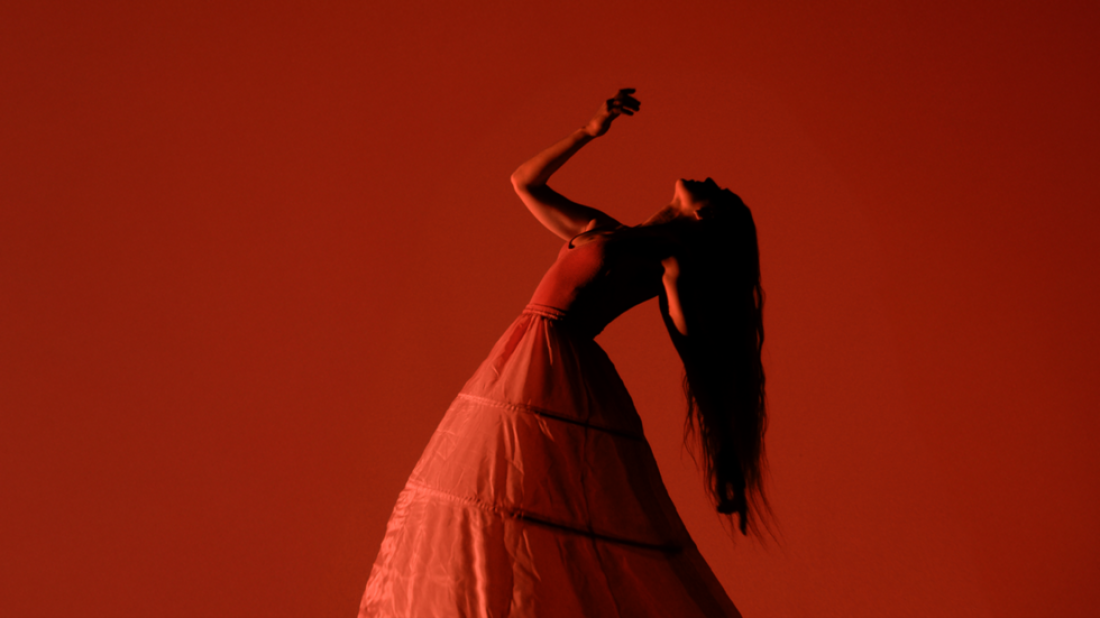
Dancer choreographer Jenn Freeman reframed her creative process after a life-changing autism diagnosis as an adult in an evening-length solo performance that premiered in 2023, Is It Thursday Yet? Alexander Hammer hide caption
toggle caption
Alexander Hammer
Jenn Freeman has spun and leapt for as far back as she can remember. But the dancer choreographer says a late diagnosis of autism spectrum disorder "changes everything" about her understanding of why she dances.
"I always just had this feeling of like, 'Oh, it must be me.' And over time, that really starts to weigh on you. You really start to believe that something is off. But you have no idea what it is," Freeman told Morning Edition host A Martínez.
"One of the very first thoughts that I remember having when I got my diagnosis was I wish that I had known this much sooner because there was a an immediate grieving process for all of the confusion that I've experienced in my life and all of the moments that I couldn't make sense of because I didn't have the tools and I didn't have the language to do it."
Freeman's journey navigating receiving that diagnosis when she was 33 and already well into her artistic career is at the heart of Alexander Hammer's documentary Room to Move, now out on Netflix after premiering at the Tribeca Film Festival last year.
YouTube
Hammer also directed the 2020 TV mini-series Expecting Amy, which follows comedian Amy Schumer as she faces pregnancy complications and creates a stand-up special. During the series, Schumer's husband Chris Fischer receives a diagnosis of autism spectrum disorder (ASD).
"It was when I was watching him in the docuseries that my head exploded. It was the first time I had ever once thought, ever in my entire life that I might be autistic," Freeman recalled.
"I don't know where I would be right now if Chris and Amy had not been brave enough to share that part of their journey. I'm so grateful that they ended up keeping that as part of the film because it's changed my entire life."
Schumer and Fischer are among Room to Move's executive producers.
YouTube
Freeman began to re-examine her childhood memories through the lens of her diagnosis, realizing what the adults around her called dance at the time was also a form of self-therapy. In 2023, she premiered Is It Thursday Yet?
The evening-length solo piece — co-created and co-choreographed with Tony winner Sonya Tayeh — reframes Freeman's creative process through the lens of her diagnosis, amplified with some of the extensive video footage her father shot during her childhood.
"A lot of traits that I had as an autistic child were seen as good things and they were rewarded," Freeman said. "My intensity, my passion, my love of repetition, of practice, of doing things over and over again, of wanting to get things right. So there's that perfectionism piece that as a young dancer is not a bad thing."
She also pointed to how she would stay quiet and avoid conversations. "I wanted to avoid conflict because if anything came up or anything got heated, I would shut down. So if I felt unsafe or it felt like an unfair fight, I would just shut up and do what I was told. And in the dance studio, that really worked for me," Freeman explained.
On her own artist website, she now identifies herself immediately as an "Autistic American" dancer, choreographer and educator.
Freeman says her ASD likely wasn't detected early because she grew up in a small Idaho town in the 1980s and 1990s where there was a lot less discussion about such disorders. Making the documentary, she says, is her way of giving back.
"The way that I found out that I was autistic from someone else sharing their personal experience. And that's really my only intention with all of this, is just to put it out into the world and hope that someone sees themselves in my story or parents see their child and there's just a little bit more understanding. Maybe it will spark, you know, some conversations for people."
The broadcast version of this story was produced by Barry Gordemer.


