
ByTom Bennett and the Visual Journalism team
Wildfires are tearing through France and Spain, forcing more than 300,000 people to evacuate their homes.
France has seen more land burnt than any year this century, while officials in the Spanish capital Madrid say the fires are the worst the region has ever experienced.
It follows a sweltering summer of heatwaves across Europe that have seen temperatures soar above 40C (104F) in many places.

One of the worst affected areas is in Gironde, around the French city of Bordeaux, where more than 200,000 people have been forced from their homes.
The blaze has spread rapidly, tearing through forests and fields in France's famous wine region, and burning more than 162 sq miles (420 sq km) in less than four days - an area roughly four times the size of Paris.

It is now just nine miles (15km) from the south of Bordeaux.
The fires have also threatened a number of sensitive military and industrial sites in the area, including facilities that work on French ballistic missiles, rocket motors, and the processing of hazardous chemicals.
The fires have become so extreme they have created their own giant fire thunderstorm.
A rare weather event, storms like these are formed when heat from the wildfires makes the air above the fire rise rapidly, carrying smoke, ash and water vapour high into the atmosphere.
As the air rises, it cools, and the water vapour condenses into a cloud. If the fire is powerful enough and the atmosphere is unstable, that cloud can grow into a cumulonimbus - the same type of cloud associated with thunderstorms.

If these clouds then become large enough, they can produce their own lightning, which can then start new fires. They can also occasionally bring hail and rain.
These extreme and unpredictable conditions make the fires all the more difficult to stop.
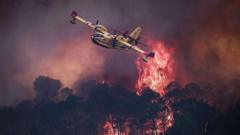
To combat them, French firefighters have been using planes loaded with fire retardant, as well as planes like the Canadair, which can scoop 6,000 litres of water from lakes or the sea in 12 seconds and drop it directly on the fires.
On dangerous days, loaded aircraft patrol high-risk areas before any fires have been reported, so they can drop within minutes of a sighting. Planes often fly in a continuous shuttle while retardant is laid along the edges of the fire and ground crews attack the flames directly.
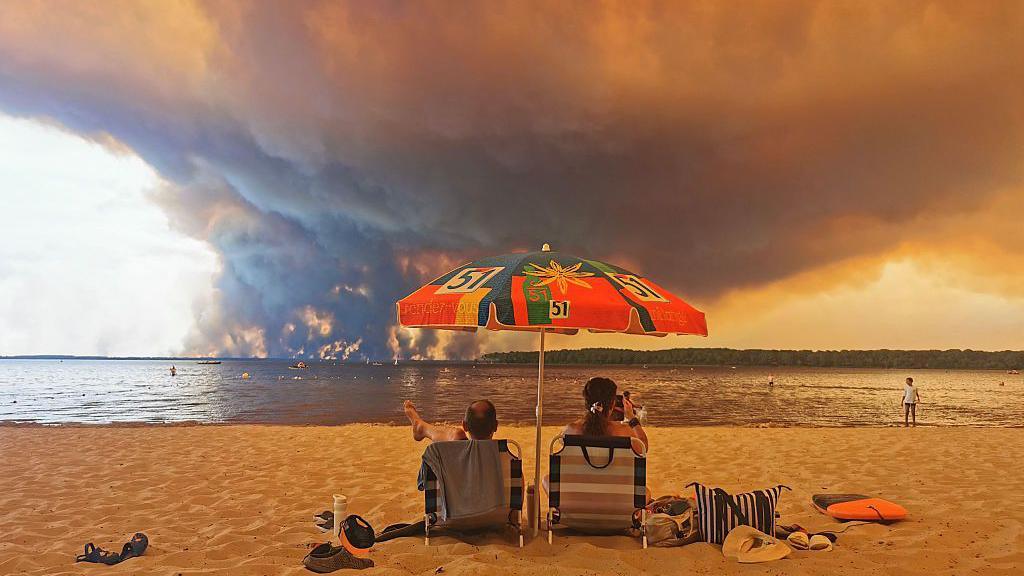
Image source, AFP via Getty Images
Image caption, The fires near Bordeaux are in an area with many lakes

In Gironde, about 2,500 firefighters, 1,500 military personnel, and 1,200 police officers and gendarmes have been involved in tackling the blaze.
Around the town of Lacanau, bulldozers, diggers and mechanical shovels have been used to carve a firebreak that is 100m (328ft) wide at points, according to French media.
A firebreak is essentially a stretch of land that has been stripped of all vegetation to stop the fire from spreading. It is key to strip the land of any potential fuel before the fire has a chance to reach it.
Spanish teams have been using many of the same techniques.
Francisco Martin, a government delegate in Madrid, described the fires as "undoubtedly the largest fire in the history of the Madrid region".
This summer's fires have been aided by the hotter, drier conditions caused by climate change, which allow fires to spread faster and burn more fiercely.
Many on the ground - in both Spain and France - are fearful that the coming week could see worsening conditions, with high pressure forecast to bring dry, settled and increasingly hot temperatures.