Nine months after a New York jury convicted Sean "Diddy" Combs of transporting prostitutes across state lines for drug-fueled sex parties, the hip-hop mogul is set to appear in a federal appeals court on Thursday to challenge his lengthy prison sentence.
Acquitted last year of the more serious charges of racketeering conspiracy and sex trafficking, Combs argues that the judge imposed an overly harsh sentence by considering the crimes for which the jury found him not guilty.
"He sits in prison today, serving a 50-month sentence, because the district judge acted as a thirteenth juror," Combs' lawyers wrote in their appeal.

Sean "Diddy" Combs attends the 2022 Billboard Music Awards at MGM Grand Garden Arena, May 15, 2022, in Las Vegas.
Frazer Harrison/Getty Images
A panel of judges on the Second Circuit U.S. Court of Appeals is set to hear the sentence challenge as well as Combs' broader argument that he should not have been convicted because his sexual exploits are protected under the First Amendment.
His lawyers claim that Combs was merely "creating typical amateur pornography" by transporting escorts across state lines to engage in lengthy drug-fueled sex parties known as "freak offs."
Lawyers with the U.S. Attorney's Office in Manhattan, who initially asked for a 11-year sentence, argue the judge was correct in taking into account the violent way Combs treated his victims when handing down his sentence.
"According to Combs, the District Court should have closed its eyes to how he carried out his ... offenses and abused his victims--violently beating them, threatening them, lying to them, and plying them with drugs," prosecutors said in their appellate brief.
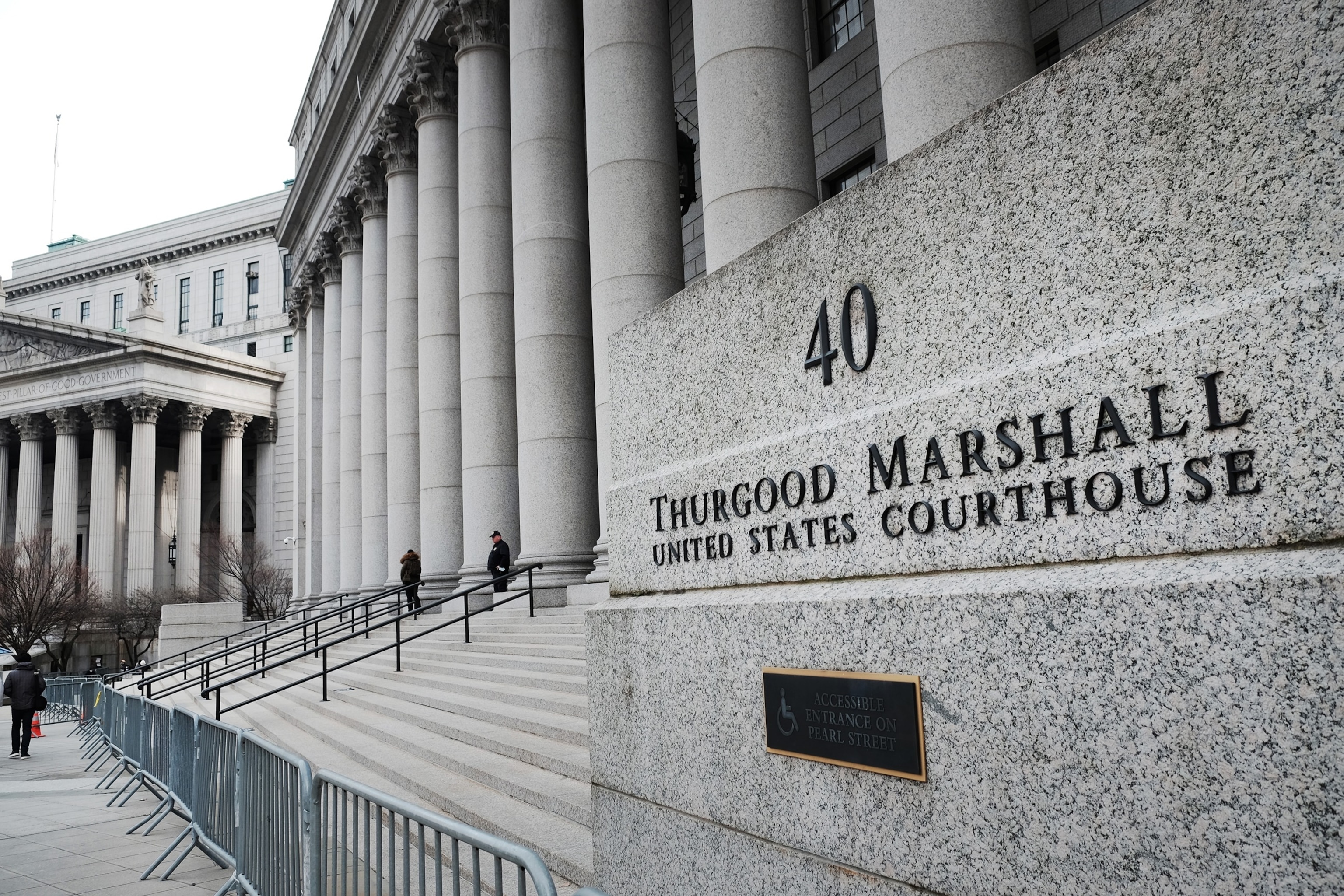
The Thurgood Marshall United States Courthouse is seen in New York, Dec. 21, 2021.
Spencer Platt/Getty Images
What was Combs found guilty of?
After a two-month trial last summer, a jury reached a split verdict against Combs, acquitting him on the more serious charges of sex trafficking and racketeering while finding him guilty of two lesser counts of transportation to engage in prostitution. Though the jury determined that Combs did not coerce or exploit his victims -- necessary elements to prove sex trafficking -- they did conclude that he transported people across state lines for his "freak offs."
Claiming legal victory, Combs' lawyers unsuccessfully pushed for his release from prison, arguing he had already served enough time in prison while awaiting trial.
U.S. District Judge Arun Subramanian rejected those arguments and handed down a 50-month sentence, saying Combs was able to get away with violent and abusive conduct for years.
"The court is not assured that if released these crimes would not be committed again," said Subramanian, who added that a lengthy sentence was needed "to send a message to abusers and victims alike that exploitation and violence against women is met with real accountability."
How much time does Combs have left in his sentence?
After spending about 14 months in the federal jail in Brooklyn ahead of his trial and sentencing, Combs has been serving his sentence at the federal prison in Fort Dix, New Jersey. In addition to having those 14 months taken off his overall sentence, Combs is also likely eligible for a reduction in his sentence under the First Step Act and by participating in a drug rehabilitation program.
Popular Reads
According to the federal Bureau of Prisons, Combs' tentative release date is April 15, 2028.
What is Combs' argument to reduce his sentence?
Combs' lawyers have argued his sentence is "unlawful, unconstitutional, and a perversion of justice" because it factored in conduct for which the jury acquitted Combs.
"The jury refused to authorize any punishment for coercive sex or conspiracy--because the evidence showed there was none," his lawyers wrote in a reply brief. "The jury only authorized punishment for 'prostitution.' It never authorized a sentence four times the typical sentence for that crime."
Prosecutors pushed back on those arguments, arguing that the federal sentencing guidelines allow the judge to consider relevant conduct, even if he was acquitted of those crimes.
"That is because 'acquittal on criminal charges does not prove that the defendant is innocent; it merely proves the existence of a reasonable doubt as to his guilt,'" they argued.
How does the First Amendment apply to Combs' conviction?
Combs' lawyers also asked the court to throw out the conviction altogether, arguing the prostitution at the center of his case was part of an effort to make "typical amateur pornography."
"The encounters were highly choreographed performances involving costumes, lighting, and other staged effects. Later, Combs and his girlfriends often watched the films together. Such conduct is protected by the First Amendment," his lawyers argued.
Prosecutors have told the court the transportation of sex across state lines "is not inherently expressive" conduct protected under the First Amendment.
"Combs's intent to watch the sex sessions live cannot bring his interstate transportation of others to have sex for money within the First Amendment's protection. Were it otherwise, any defendant who transported others to engage in prostitution could escape liability simply by watching or filming the sex," prosecutors wrote in their brief.