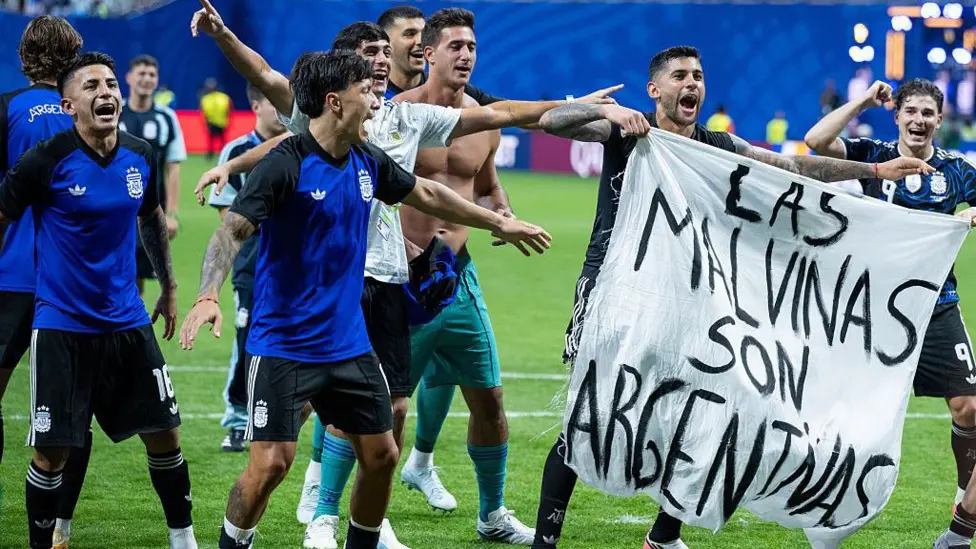
Argentina have previously been fined for holding a banner with the same message
ByAdam Millington
BBC Sport journalist
Fifa is "assessing match reports" before deciding whether to punish Argentina after players celebrated their World Cup semi-final win against England with a banner in support of their country's claims to the Falkland Islands.
The defending world champions produced a dramatic late comeback in Atlanta, scoring twice to defeat Thomas Tuchel's side 2-1 and book a showdown with Spain in Sunday's final.
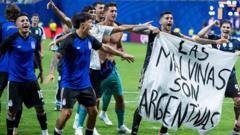
After the final whistle, Argentina players held up a banner reading "Las Malvinas son Argentinas", which translates as "The Falklands are Argentine".
The Falklands, a British overseas territory in the south-west Atlantic Ocean, remain the subject of a sovereignty dispute between the UK and Argentina.
In a statement, a Fifa spokesperson said: "As is standard procedure, Fifa's independent disciplinary committee is currently assessing the match reports and considering the relevant circumstances before deciding on potential further steps based on the Fifa disciplinary code."
Argentina's football association were fined £20,000 by Fifa in 2014 for holding a banner with the same message before a friendly against Slovenia.
At the time, world football's governing body said the gesture had breached rules on political action and team misconduct.
Downing Street has supported calls for Fifa to investigate, with the prime minister's official spokesperson saying: "The World Cup might not be ours, but the Falkland Islands definitely are. Our commitment to the Falklands will never waver."
Argentina's President Javier Milei called the players' action "understandable" and "valid", according to media reports.
But he also made clear, in comments made to Radio El Observador, that "the things that happen on the pitch are not part of diplomacy".
"Indeed, the Malvinas are Argentine, we are going to recover them, and we're going to do it in the diplomatic field, by acting intelligently," he said.
Argentina, ruled at the time by a military junta led by General Leopoldo Galtieri, invaded the islands, situated 300 miles off Argentina's east coast, in 1982.
The conflict, which lasted for 74 days between April to June 1982, led to the deaths of 649 Argentine and 255 British servicemen. Three people from the islands also died.
In 2013, the people of the Falkland Islands voted overwhelmingly in favour of remaining a UK overseas territory.
Of 1,517 votes cast in the two-day referendum - on a turnout of more than 90% - 1,513 were in favour, while just three votes were against.
What action could Argentina face?
Fifa usually take disciplinary action for general breaches of regulations by players or a country's supporters in the weeks after a tournament, although this could be taken more seriously because it occurred in a World Cup match between the two countries.
There is no prospect of Argentina losing their place in the final.
Liberal Democrat leader Ed Davey has called for the Argentina players who were holding the banner to be suspended for Sunday's final against Spain.
Davey referenced Uefa's ban of Spain players Alvaro Morata and Rodri for one game after chanting "Gibraltar is Spanish" during their side's Euro 2024 celebrations.
Gibraltar is an enclave at Spain's southern tip that has been under British rule since the 18th century and Spain have long called for its return.
There is precedent for Fifa banning a player who has held up a banner with a similar political message.
After the 2012 Olympic Games bronze medal match, South Korea midfielder Park Jong-woo held a sign in Korean which read "Dokdo is our territory".
More commonly known as Liancourt Rocks, Dokdo is a group of inlets administered by South Korea to which Japan holds a claim.
Park was charged by Fifa and a few months later handed a two-match suspension, meaning he sat out two World Cup qualifiers.
Argentina displays controversial banner after win over England
The government of the Falkland Islands said it was "disappointed" about the banner and that they hope Fifa will "sanction all behaviour of this nature in line with its own rules".
They also said "we do not wish to see politics being brought into sport".
Milei was reported by Argentine broadcaster TN as saying that it was "perfectly valid and right that the players should want to express themselves and do so".
However, he went on to say that this should not lead to "bad interpretations," adding that "It's a game of football, that's how the team manager and the veterans [in Argentina of the 1982 Falklands War] understood it".
Peter Kyle, the business and trade secretary, said it is "essential" that politics is kept out of the World Cup and called for Fifa to investigate.
"I'm really proud of our team, what they achieved, the professionalism they showed, but also the dignity that they showed," said Kyle.
"And that was in real contrast to what we saw with the Argentine team last night. When it comes to the consequences for their actions, well, that's for Fifa to do now. And I really do hope that Fifa do a proper investigation into it".
Kemi Badenoch, the leader of the Conservative Party, echoed Kyle's sentiments and said that Fifa "absolutely should investigate".