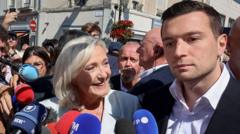

Many noted Bardella's muted enthusiasm when he appeared this week alongside Marine Le Pen
ByLaura Gozzi
A stern-looking Jordan Bardella squinted in the sun as a reporter asked him whether he was relieved or disappointed that he would not be the 2027 presidential candidate for the National Rally (RN).
"Neither," he said in a flat voice during a campaign event in the village of La Flèche. "I am glad Marine can represent us. We will work together hand in hand like we've always done."
The previous evening his mentor Marine Le Pen announced she would run for the presidency next year, and not him. In the space of 20 minutes on primetime TV on Tuesday, she put an end to the prospect of handing the party's candidacy to her protege.
Thirty-year-old Bardella has had a dizzying career up the RN ranks, but he was always measured about his prospects of becoming president.
"I want Marine to be the candidate," he had said repeatedly, making it clear he would stand only if an appeal court confirmed she was barred from running for office over a fake jobs scam.
But as party president he had been growing into the role of stand-in candidate - even going on a statesman-like visit to Poland last month. As the date of Le Pen's appeal verdict drew near he appeared increasingly excited to launch his own presidential campaign.
Instead, on Tuesday, a Paris court ended her ban on holding public office and said she should wear an electronic tag for a year. That evening Le Pen announced she and Bardella would run together as "a winning ticket". She would be president, and he prime minister.
But that is not how France's political system works.
France's next parliamentary election is not due until 2029. It is possible a victorious Le Pen could trigger a snap election soon after taking up the post of president and make Bardella prime minister - but there is no guarantee this might happen quickly.
So Bardella is left waiting.

Last month, Bardella took part in a visit to Poland, meeting party allies and touring the eastern border
Many National Rally supporters will be relieved Le Pen is running instead. She has made politics her life, has already run three presidential campaigns, and her decision has boosted her lead in the polls.
Bardella's age and lack of experience, many feared, would have come under close scrutiny and could have become a liability.
Still, Bardella's body language at Wednesday's campaign event in the north-west was telling.
While Le Pen beamed at the cameras, brushing off suggestions her deputy would mind being sidelined and insisting "our personal ambitions are absolutely irrelevant", he barely reacted and scarcely smiled.
The speedy climb in National Rally ranks that has characterised his political career seems to have stalled.
Had he been allowed to run, with his party's sizeable lead in the polls and his own strong approval ratings, by spring 2027 he could have succeeded Emmanuel Macron as France's youngest president – and the first hard-right head of state in modern French history.
Born in 1995, Bardella was brought up by his Italian-born single mother, Luisa, on the outskirts of Paris.
Although he has often said she struggled to make ends meet, his father Olivier, also of Italian origin, ran a drinks distribution business and lived in the more affluent town of Montmorency. That detail undercuts the hard-luck narrative surrounding Bardella's early years which he would later use to appeal to a wider electorate.
Neither parent was particularly political and, according to an interview a friend from his teenage years gave to Le Monde, nor was the young Bardella, preferring to spend time on his PlayStation and streaming his Call of Duty sessions on a YouTube channel called Jordan9320.
Yet when he decided to join the far-right National Front as a 17-year-old in 2012, he climbed the ranks quickly. He was made local departmental secretary at 19 and regional councillor for the Paris region at 20. Along the way, he dropped out of university to focus on his political career.

Jordan Bardella and Marine Le Pen during their last appearance before the verdict in Le Pen's appeal trial
Bardella would later attribute his initial decision to join the party to a fascination with Marine Le Pen, who had taken the reins of the party from her father Jean-Marie Le Pen in 2011 and was working to turn it from a fringe, extremist movement into a respectable political force.
"There's something about her that others don't have," Bardella said in 2021. "She has a character, an energy... a courage that speak to me."
That interest was reciprocated.
Early on, he entered the RN's inner circle through his relationship with the daughter of an old National Front hand, Frederic Chatillon; by 2017, Le Pen had named Bardella party spokesman. Around the same time, Bardella started dating Le Pen's niece, Nolwenn.
Two years later he became the European Parliament's second-youngest MEP, and at 27 – already one of the party's most visible figures – he was elected National Rally president.
In 2024, it looked like Bardella would make another leap ahead. National Rally emerged with 33% of the vote in the first round of snap parliamentary elections, bringing him within touching distance of becoming prime minister. Eventually, a centre-left alliance won the second round.
But in the two years since, Bardella's popularity has remained solid. In early July, his approval rating was at 40%; Marine Le Pen's has remained stable at 39%.

Italian socialite Princess Maria Carolina of Bourbon-Two Sicilies and Jordan Bardella have been an item since early 2026
Bardella's appeal has always been, in great part, his capacity to appeal to a large part of the electorate.
He speaks to the youth vote through his social media channels, where he has two million followers.
His relationship with Italian socialite Princess Maria Carolina of Bourbon-Two Sicilies has given him a glamorous edge, but he frequently references his modest upbringing.
His politics broadly follow Le Pen's talking points - a standard anti-immigration stance and populist rhetoric.
Mass immigration was "shaking the balance of European countries, of Western societies, and namely French society", Bardella told the BBC, and he said his first move as president would be to trigger a referendum on immigration to "allow France to take back control of [its] borders".
In a nod to business leaders, he has promised to shield entrepreneurs "from an unbearable fiscal and regulatory straitjacket".
He pleases Eurosceptics, sayings he wants to renegotiate France's membership of the EU, viewing it as "profoundly old-fashioned" and "obsolete", and he has even suggested halving France's contribution to the EU budget.
But he insists he is not looking to "destroy anything", reassuring more cautious voters.
His chameleon-like qualities have led some to call Bardella an "incredible blank canvas" upon which RN voters can project their ideal candidate. But he is also "a huge question mark", Lecturer Pierre-Henri Tavoillot says. His true ideological make-up "is unclear... and his smooth image allows him to cast a wide net".
In the year he spent acting as Le Pen's Plan B, most of his focus was on domestic politics.
But he has talked of looking at France leaving Nato's integrated command, after the end of the Ukraine war, and has condemned Macron's proposal to extend France's nuclear deterrence to European allies as a potential "national betrayal".
He has also been building ties with Europe's nationalist right - from Giorgia Meloni to Poland's PiS - while distancing himself from US President Donald Trump, whom he has called "erratic".
For a year, he had to pull off a delicate balancing act ahead of the Le Pen appeal verdict: to appear as both poised for the presidency and prepared to make way if Le Pen was ultimately allowed to run.
He spoke of being "calm and ready to accept the consequences".
Now the decision has been made for him, all Jordan Bardella can do is allow his mentor and maker to return to the spotlight she feared would never be hers again.