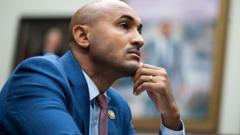
Barely a year after his election in 2024, Figures helped secure $1m (£746,885) from the US government to help build a civic centre in Tuskegee. It will serve as a fallout shelter against deadly storms and also house the city's police department and the fire department that came to Benham's aid.
But just as federal funds were arriving, the political winds shifted.
This April, the US Supreme Court struck a blow to a part of the Voting Rights Act that had helped give minority voters more representation in Congress. The ruling has allowed Republican-led states across America's South to redraw congressional maps to erase majority-black districts.
The changes could help shift the balance of power in Congress in November and either halt or help drive President Donald Trump's agenda for the rest of his presidency.
Some residents and city officials in Tuskegee fear that if Figures loses under a new map, then they will lose out too.
"All of our issues, we do depend on federal funding," Tuskegee Mayor Chris Lee said.
"It's very important that we have someone who has our back."
On a drizzly morning in June, all was still on Tuskegee's South Main Street, a two-lane road that runs into the heart of the town square, where a towering Confederate monument loomed over the emptiness.
Vines snaked through broken windows on abandoned buildings, street after street.
City officials had grown optimistic with Figures in office, but worry has started to creep in since the Supreme Court allowed the state to dissolve his district.
Figures, a Democrat, now goes into November's midterm elections defending a redrawn, white-majority seat. Research shows roughly 83% of black voters support the Democratic Party, while non-Hispanic white voters are more likely to lean Republican.
"I hate that this happened, especially this early," Tuskegee's mayor said. "We're really just at the tip of the iceberg of seeing the real impact."
In the years before Figures, Tuskegee was lumped into a more white, more conservative district.
"I cannot even remember seeing our congressman before," Mayor Lee said.
The area was represented by Republican Mike Rogers who did not respond to the BBC's request for comment.
States customarily redraw their maps every 10 years to reflect population changes in a process called redistricting. Sometimes, the party in power - Democratic or Republican - will try and draw the new lines in their favour.
Other times - as was the case for Figures' district - courts intervene when states are accused of breaking the law.
In 2023, the US Supreme Court struck down a congressional map drawn by Alabama's Republican-led legislature. It ruled that the map violated a key clause of the 1965 Voting Rights Act by unfairly dividing black voters in southern Alabama across multiple districts, diluting their voting power.
A new map was forced on the legislature, which resulted in two seats where African Americans were in the majority, or close to it.
Most liberals have supported the creation of such majority-minority districts over the past half century as a way to overcome historical discrimination - although some have worried it could limit black voting power to just certain districts. Conservatives, meanwhile, say such gerrymandering is itself discriminatory because voters are explicitly categorised by their race.
For Figures, a native of Mobile, Alabama, it was a long-awaited opportunity.
"When you come from those communities, when your people come from a line of those communities, you care more about making sure that you leverage the position that you're in for the benefit of all communities," Figures says.
But in April, the Supreme Court changed course, issuing a new ruling that makes it significantly more difficult to challenge maps based on racial discrimination.
"I think it's purely racially motivated," Figures says about Alabama's desire to use the latest map. "There's literal evidence in the record of state legislators referring to Montgomery during the redistricting process as 'monkey town.'"
That text message was cited by the three judge panel that first blocked Alabama's map. Montgomery, the state capital, is over 60% African American. Like Tuskegee, it will become part of the newly redrawn second district.
Alabama Attorney General Steve Marshall says efforts by Republicans in the state to pry power from Democrats are partisan political battles, and not motivated by race.
"I don't believe that there's been a direct targeted history… in a way that suppresses minority voter participation," he adds.
He points out that Democrats have redrawn the maps in states that lean to the left politically, such as California, to boost their chances of winning more seats. Republicans, he says, are following the same "race-neutral" principles.
Cedric Coley, chair of the Alabama Young Republicans, says his state is strongly conservative and deserves representatives who reflect those values. He does not want federal judges interfering in the redistricting process, not even to prioritise black Americans like himself.
"I would rather have family disputes, with the people of Alabama, instead of federal judges stepping in and saying because your past is racist, we must be racist in the future and create racial maps, and box people in racial quotas. I just don't believe that."
Coley says people should be judged on merit. "You don't base it off the content of someone's skin or where they come from," he adds. "It's based on what they've earned."
Many black Alabamians, however, simply don't buy the argument this is just about party politics.
"It's a big setback for black people," Joe Reed, a Montgomery-based civil rights activist and lawyer, tells the BBC. "You can discriminate based on politics, but you can't discriminate based on race. Well, hell, in Alabama, with the polarised voting we have, everything is race. Everything."
Sixty-two miles east of Tuskegee is the rural outpost of Eufaula, where pickup trucks haul fishing boats to the muddy banks of the nearby Chattahoochee River. Being part of a congressional district with a majority of black voters has special significance here, where, in 1874, a white mob fired hundreds of rounds into a group of black men headed to vote, killing six.
Eufaula's population is now racially diverse, with white and black residents accounting for roughly 45% each. But inequality remains high. Black residents here experience poverty at more than four times the rate of the white population – at nearly 57%.
Resident Mary Porter lives on a fixed income with no means of transportation.
The 71-year-old recalls marching as a child to pass the 1965 Voting Rights Act, which made it illegal to discriminate against race in voting practices (the same landmark legislation was used to help create Figures' district - and is the same act the Supreme Court has gradually weakened in recent years).
"We should have a voice here, and it should be equality and justice for all," she says.