For 30 years, a dead body known as "Green Boots" has been lying in the snow, nestled under an overhanging rock, not far from Mount Everest's summit.
The lime mountaineering boots worn by an Indian climber who died in 1996 have been a grim trail marker for many climbers on their way up the world's highest peak ever since.
Now India is looking for a specialist high-altitude recovery team to undertake a complex and risky mission to retrieve what they say is Dorje Morup's body – arguably the most famous of the hundreds whose bodies have been left frozen on the mountain.
They hope they are on the cusp of returning his remains to friends and family who never gave up hope he'd come home.
"On some days, before I went to sleep, I would think that there'd be a knock on the door tonight and that when I opened, he would be there," Morup's wife told the BBC.
"When he comes home, I will ask him: 'Where were you all these years?'"
The night before he left to be part of a historic Indian expedition on Everest, Morup sat with his wife at his home in Ladakh, an Indian-administered territory in another part of the Himalayas.
He made her a promise: that he would come back a hero and make his country proud.
"He asked me to take care of the kids and come to the airport to greet him on his return," Konchak Yangskit told the BBC at her home.
A lance naik, or lance corporal, in the Indo Tibetan Border Police (ITBP), the force guarding much of India's border with China, 48-year-old Morup was no stranger to Himalayan trekking.
But Yangskit says she had a strange sense of foreboding that night: "I wondered if I was ever going to see him again."
Morup was one of six climbers on the ITBP expedition attempting to reach the top of Everest – which lies on the border between Nepal and the Chinese-governed territory of Tibet.
Most climbers choose to ascend from the Nepalese side, but Morup's crew wanted to write their names into the history books as the first Indian expedition to do it from the treacherous Chinese side.
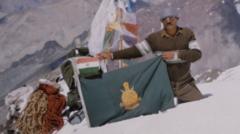
Three out of six members of the expedition turned back due to a snowstorm, but Morup and two others - Tsewang Smanla and Tsewang Paljor – kept struggling, all the way up to the 8,849m summit.
Disaster, a blizzard, struck as they descended and killed all three.
Like many of the more than 300 people who have died in the Everest region since records began a century ago, their bodies remain on the mountain.
Two have never been found, but the third body - that of "Green Boots" - has been lying frozen in the snow for three decades at an altitude of 8,500 metres.
For years, it was assumed that "Green Boots" was another member of the expedition, Tsewang Paljor.
But testimony from surviving members of the 1996 expedition and the location of the last radio contact with the climbers have now led authorities to believe the remains belong to Morup.
Retrieving those who have died on the mountain is a dangerous, gruelling task, and, up until the past decade, very rare.
Many of the bodies, like Morup's, are in what climbers call Everest's death zone – where temperatures can plunge to -40C and oxygen levels are about a third of those at sea level.
"The weather and snow conditions are going to be crucial," said Tshiring Jangbu Sherpa, a prominent Nepalese mountaineer who has taken part in other recovery missions.
"The north side has fewer crevasses, but it is riskier. If something bad happens from the Nepalese side, you get quickly evacuated by helicopter. But there is no such system from the Chinese side," he told BBC Hindi.
The Chinese side of the peak – where Green Boots' body is – is steeper and doesn't have the same support structures as the southern slope, which is another complicating factor, Sherpa sources have told BBC News Nepali.
"It's really tough to get that body down even in popular spring season, let alone the autumn [which has more unpredictable weather]. That's the simple reason it is still there for so many years," mountaineering guide Pemba Ongchu Sherpa said.
"There would need to be 10 to 12 climbers who are capable of making summits, just to fix [support] ropes to reach that point."
Green Boots will also have to be physically carried down to an altitude where it can be collected by a helicopter, or possibly yaks, and transported back to an airport – a job which also requires huge manpower.
Sherpas say bodies shrouded in iced-up climbing gear often weigh several times the average man and are frequently frozen into awkward positions, making bringing them down the challenging terrain even more treacherous. The remains may also begin defrosting and decomposing once they reach lower altitudes.
The start of the descent with the body would be the most difficult, Indian climber Kuntal Joisher told BBC Nepali.
"It's going to be very, very risky endeavour. It's extremely steep ground with lots of rock. Logistically, this [first] 1000m is going to be a humungous challenge."
"The main thing is to not put Sherpa lives at risk for a dead body."
All of this makes for a hugely expensive recovery mission – experts say even the most straightforward ones cost between $40,000 and $80,000, a sum beyond the means of most families.
It is more common for local teams to move people who have died out of view on the mountain: like explorer Francys Arsentiev, dubbed the Sleeping Beauty of Everest, who in 2007 was moved to a more private final resting place on Everest almost a decade after she died.
But the ITBP – which is funding the recovery operation – wants Morup's body to be returned by September, and is looking for mountain rescue Sherpa groups who could do the job.
Once returned to India, the body will undergo DNA testing and, if confirmed to be Morup, his remains will be given back to his family.
All that remains of Morup today are his medals and trophies, a couple of old photos from his mountain adventures – and, most importantly, a certificate from the Chinese government which states that at 17:30 on 10 May 1996, Morup reached the top of Everest.
If the recovery mission is successful, Morup's son Punchok Dorjai told the BBC that the family would hold a funeral for him near the Martyrs Park in Ladakh's capital Leh.
"My father gave his life for the country and he should be remembered as a martyr," Dorjai said, adding that his teammates who perished deserve the same title.
The family will also proudly save a symbol of Morup's legacy at their home, to go alongside his summit certification, he said: "We are planning to keep the Green Boots."
Additional reporting by Pradeep Bashyal, BBC News Nepali