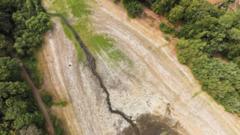
Dr Katie Facer-Childs from the UK Centre for Ecology & Hydrology says there is not a straightforward answer to when this drought might end, because it has not been caused simply by a lack of rainfall, but also higher than average temperatures.
"This year we've gone through meteorological, soil moisture, and river flow drought," says Facer-Childs.
Meteorological drought is when rainfall is below normal.
Next comes soil moisture drought, which begins to affect agriculture. Soil is like a type of reservoir - those stores are depleted by thirsty trees and plants, and evaporation during hot temperatures.
Then comes river flow drought, where river levels fall, and, finally, if dry conditions persist for long enough, groundwater and reservoir levels decline, leading to the most serious impacts.
"However, we have not yet reached severe groundwater and reservoir drought, so that means there's hope," says Dr Katie Facer-Childs.
The British Geological Survey, external says no groundwater sites around the UK are currently reporting record lows - with nearly half at normal levels.
The first clear indication usually comes in late autumn and winter, when we typically see more rainfall and experts can assess whether that water is moving through rock layers into underground stores, known as aquifers.
Dr Kevin Collins, senior lecturer in environment and systems at The Open University, says even when autumn rains arrive, people often assume the drought is over.
But sustained rainfall is needed over months rather than a few heavy rainfalls.
Hydrologists should know by February or March whether aquifers and and human-made reservoirs have been replenished. But recovery from the environmental impacts can take years.
A dry winter will make the current drought worse and heighten government concerns.
Prof Tim Palmer of Oxford University says it will be "catastrophic" for the UK next year if the rains do not come.
There is some hope. Over Europe, there are signals for a wetter-than-average autumn, potentially influenced by global ocean changes, including the developing El Niño weather phenomenon. However, there remains considerable uncertainty.
"The government needs to start planning for a worst-case scenario where the rains don't return in sufficient amounts this winter, and next summer is similar to the last two," Prof Palmer says.