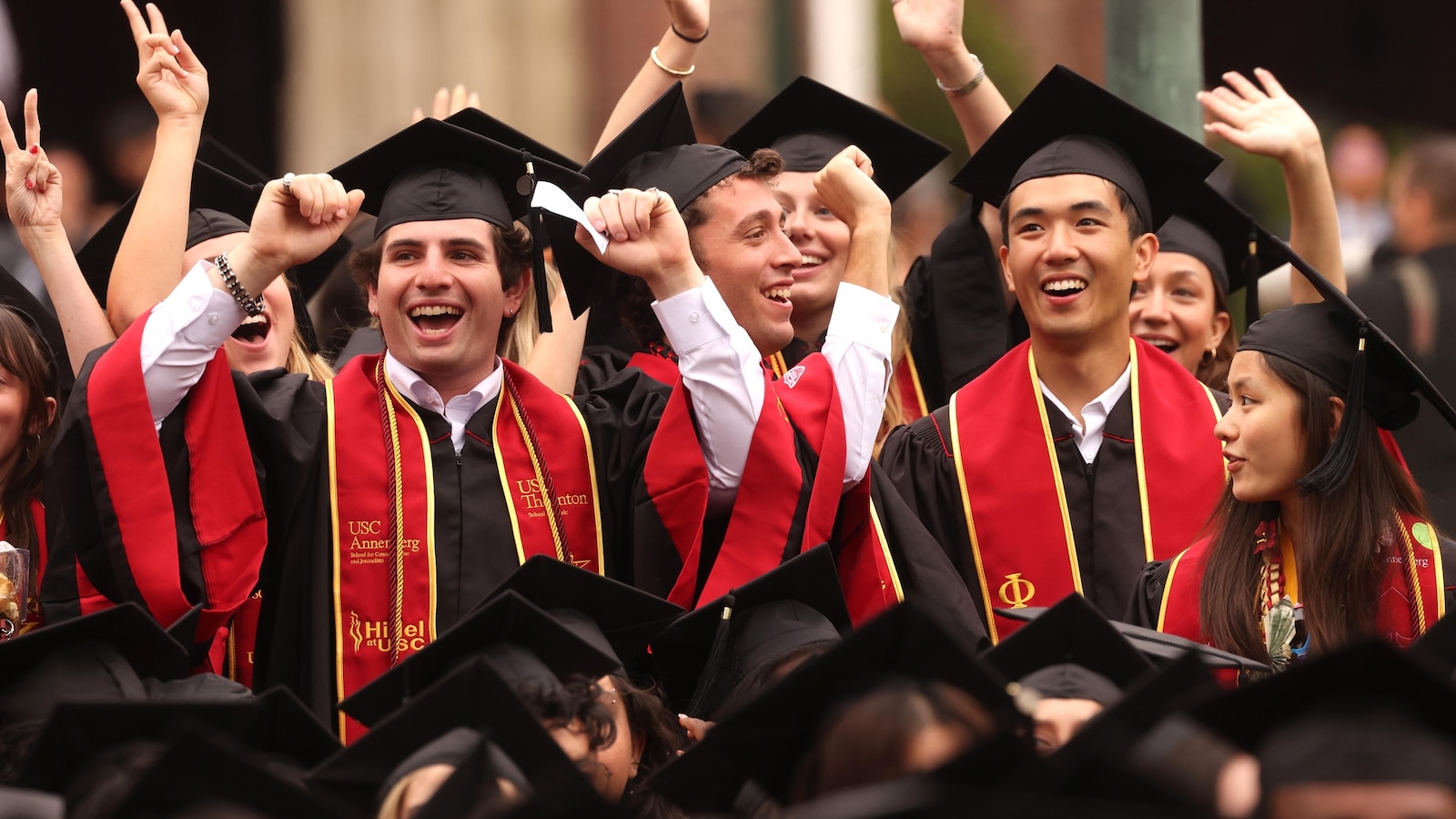
Millions of young adults may face a jolt of reality this summer as they step off the college graduation stage and into the job market.
The unemployment rate for recent college graduates registers at 5.6%, notably higher than the overall unemployment rate of 4.2%, New York Federal Reserve data showed. As recently as four years ago, the unemployment rates for the two groups were nearly identical.
The New York Fed labeled the job market for college grads at the outset of this year "challenging."
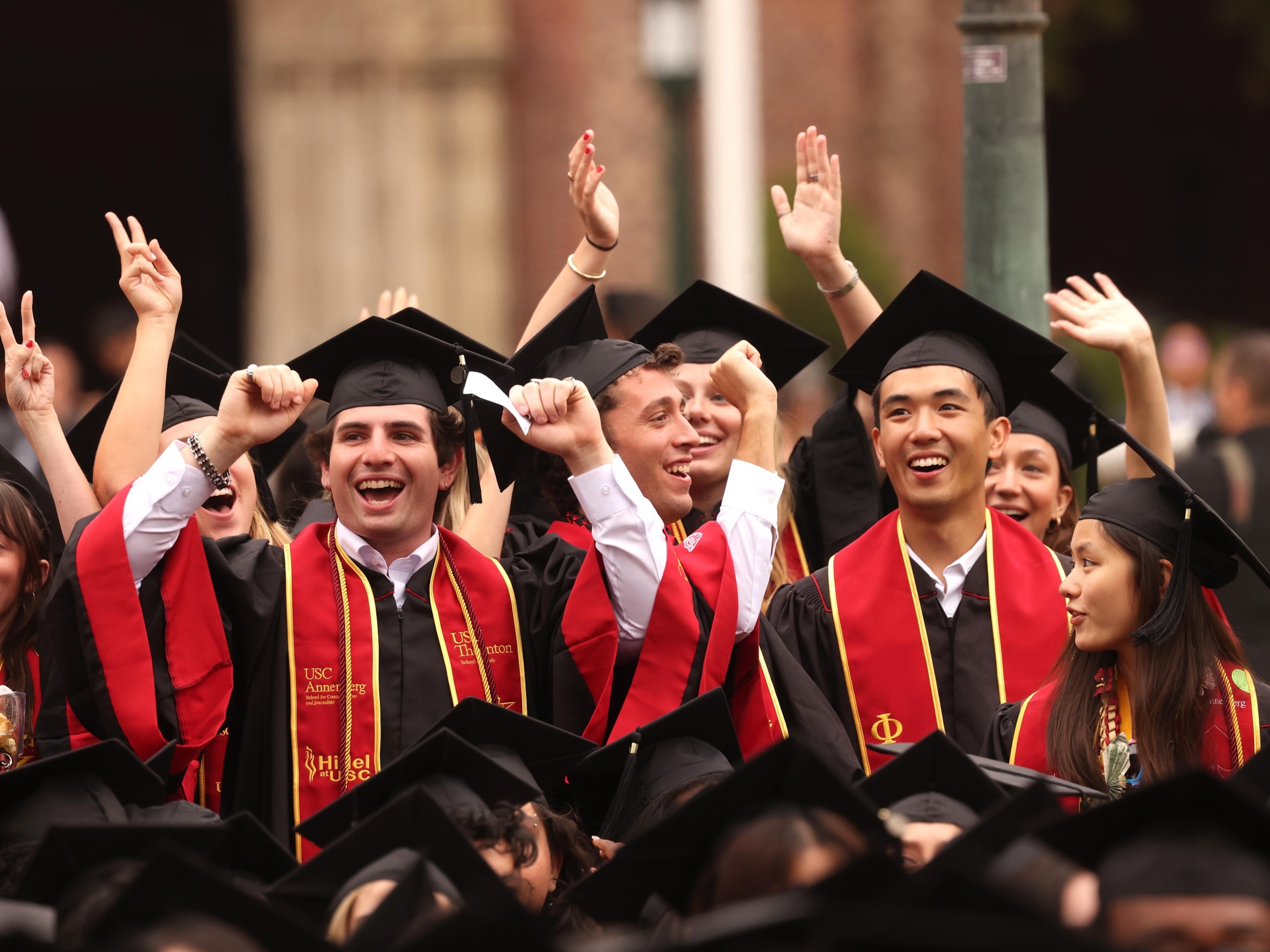
Graduates celebrate after receiving their diplomas during the USC Annenberg commencement ceremony in Los Angeles, May 15, 2026.
Genaro Molina/Los Angeles Times via Getty Images
Those gloomy prospects come as some tech leaders warn that artificial intelligence could decimate low-level positions, often taken up by recent graduates. Anthropic CEO Dario Amodei, whose company operates an AI model called Claude, said last year that the technology could cut U.S. entry-level jobs in half by 2030.
In theory, AI could upend low-level work as recent college graduates enter the job market, eliminating many positions at the bottom of the white-collar career ladder or at least reshaping them.
For now, however, analysts disagree about the extent to which AI is to blame for the weak job market faced by newly minted diploma-holders.
Economists who fault AI pointed to comparatively sluggish job gains for recent graduates in industries considered vulnerable to the technology. Uncertainty alone, they added, may be enough to deter hiring as some firms await potential AI fallout.
Skeptics, by contrast, highlighted a "low hire, low fire" labor market with few new positions for anyone, let alone recent graduates who may require more training than their older counterparts.
"There's no question that there's been a really dramatic slowdown in new hiring," Harry Holzer, a professor of public policy at Georgetown University and a former chief economist at the U.S. Department of Labor. "The question is: Does AI exacerbate that?"
Researchers at Stanford University published a widely read study last year that affirmed fears of an AI-induced hiring slowdown for young workers, at least in some sectors.
Early-career workers, aged 22 to 25, in occupations highly exposed to AI disruption -- such as customer service and software development -- suffered a 16% decline in employment relative to experienced employees in recent years, the study found. On the other hand, the study said, employment for young workers maintained at the rate of their older counterparts in fields less vulnerable to AI.
The relatively bleak fortunes for young workers in jobs vulnerable to AI appeared to begin after the release of OpenAI's ChatGPT late in 2022, the Stanford researchers found, suggesting uptake of the popular chatbot may have hindered the job prospects of some applicants.
The findings align with a view shared by Laura Ullrich, director of economic research at the job search platform Indeed, who told ABC News the effects of AI have played out on a sector-by-sector basis.
Popular Reads
A nursing degree could lead to a speedy hire in the fast-growing and relatively AI-immune healthcare industry, she noted. But a computer programming degree could put a job seeker at risk of a long search, according to Ullrich.
"The job market isn't terrible for all graduates -- it really depends what your degree is in," she said.
Some analysts, however, cast doubt on whether AI has shut recent graduates out of work much at all. They pointed to a paucity of hiring across the economy, leaving young workers in a difficult position as they compete with more experienced applicants.
Photo illustration of AI artificial intelligence technology .
Adobe Stock
The hiring rate stands at 3.5% as of March, the most recent month on record, U.S. Bureau of Labor Statistics data showed. Four years earlier, that figure registered at a more robust level of 4.4%.
The current graduate cohort would not be the first to face a difficult job market shaped in part by economic strain. Many young workers struggled to find jobs in the aftermath of the 2008 financial crisis, and a similar challenge befell graduates who entered the workforce in the immediate aftermath of the COVID-19 pandemic.
"We're seeing a slowdown in new hiring -- and new hiring is what young people depend on," Holzer said. "We saw it in the Great Recession. We saw it in the pandemic."
Jed Kolko, a senior fellow at the Peterson Institute for International Economics, disputed the findings of the study at Stanford University and others like it linking AI to hiring woes.
In a report for the left-leaning Brookings Institution in March, Kolko said different studies had set forth inconsistent definitions of occupations deemed vulnerable to AI disruption. Plus, the studies offered limited predictive value, he said, since jobs considered at-risk would change as the technology evolves
"None of this research is -- nor could be -- the last word," Kolko added, calling it "collectively inconclusive."
For their part, the co-authors of the Stanford study published a follow-up report in February highlighting the job impacts of economic forces such as interest rates, while maintaining their finding of AI-related impacts in some vulnerable fields. The researchers broadened their outlook on the onset of meaningful AI-specific impacts from as early as 2022 to 2024.
"Even if employment outcomes diverge notably only after the release of ChatGPT, this could be driven by other changes that occurred at the same time," the report said.
To be sure, many college graduates are finding jobs, defying a doom-and-gloom view of the labor market, Ullrich said. Still, as AI remains a focus for many companies, she added, the implications for young workers will continue to draw close scrutiny.
"We don't know what the path forward will be," Ullrich said.