
NEWYou can now listen to Fox News articles!
Former Sen. Kyrsten Sinema is continuing to challenge the lawsuit brought by the wife of her former security guard and lover, Matthew Ammel. Sinema has admitted to having an affair with Ammel while she was the Democratic senator from Arizona. Heather Ammel’s lawsuit alleges the tort of alienation of affection, an action many may find outdated in our more open or indulgent culture. I start teaching my torts class this week, and the alienation tort remains a controversy at the intersection of tort and constitutional law.
There was a time when most states had morality crimes that punished adultery or homosexuality. They have been largely scrubbed from our books due to constitutional challenges and changing social mores. However, a spouse can still sue civilly over a third party ruining a marriage through adultery.
Such "heart balm" actions go back to the earliest days of tort liability. However, the tort has been abolished in 42 states, leaving Hawaii, North Carolina, Mississippi, New Mexico, South Dakota and Utah as the exceptions.

FILE - Former Sen. Kyrsten Sinema, I-Ariz., speaks to reporters in the Ohio Clock Corridor in the U.S. Capitol on Tuesday, December 9, 2025. She is now being sued by the wife of her former security guard and lover. (Bill Clark/CQ-Roll Call, Inc via Getty Images)
Early tort cases spoke of two violative acts: enticement and seduction. The tort of enticement "involved assisting or inducing a wife to leave her husband by means of fraud, violence, or persuasion." Seduction was more straightforward and only required "an adulterous relationship between the plaintiff’s spouse and the defendant."
Critics have long charged that this tort is based on early concepts of the wife being the property of the husband and that there are lingering constitutional questions over holding individuals liable for consensual sexual relationships.
That proprietary element echoes in some of the earliest English cases, such as Winsmore v. Greenback in 1745. In that case, a man was sued for "maliciously and wickedly intending to injure the plaintiff … and to alienate the affection of the wife from the plaintiff." The court found that the paramour had "persuaded procured and enticed the said wife" and thereby denied the husband of his "exclusive and legally enforceable right to his wife’s service." Winsmore v. Greenbank, Willes 577. 125 Eng. Repts. 1330 (1745)); see also Michele Crissman, Alienation of Affection: An Ancient Tort – But Still Alive in South Dakota, 48 S.D. L. Rev. 518, 519 (2003); Jamie Heard, The National Trend of Abolishing Actions for the Alienation of a Spouse’s Affection and Mississippi’s Refusal to Follow Suit, 28 Miss. C. L. Rev. 313 (2008-2009).
State courts have found the action to be outmoded and abused:
"The public ha[s] come to look upon ‘heart balm’ suits as devices for extracting large sums of money without proper justification. They [a]re a fruitful source of coercion, extortion and blackmail. Manufactured suits, with their always present threat of publicity, [a]re often used to force a settlement . . . [T]here is good reason to believe that even genuine actions [a]re ‘brought more frequently than not, with purely mercenary or vindictive motives; that it is impossible to compensate for such damage with what has derisively been called ‘heart balm’ . . . and that no preventative purpose is served, since such torts seldom are committed with deliberate plan.'" Magierowski v. Buckley, 121 A.2d 749, 756 (N.J. Super. 1956).
North Carolina is one of the holdouts. Sinema’s counsel moved the case to federal court and then sought to dismiss it on the jurisdictional grounds that none of the sex occurred in North Carolina.
In depositions, Sinema confirmed sexual encounters beginning in California at the home of her friends Penny and Grant Croissant: "We were staying at an Airbnb in Napa, California. We were outside. Matt kissed me. We went inside and had sex."

Jessica Dean attends the CNN Searching for Spain with Eva Longoria Screening and Reception on April 21, 2025 in New York City. Sinema testified that she had sex with Matthew Ammel while in New York City for Dean's wedding in June 2024. (Noam Galai/Getty Images for CNN)
She also detailed having sex with Ammel at the wedding of CNN anchor Jessica Dean in New York City as well as at her Washington, D.C., apartment, in Arizona, and in Colorado.
The jurisdictional question is whether the denial of sex in North Carolina means that the courts there lack jurisdiction, as opposed to the claim that the shattered marriage, and injury, still rests in North Carolina.
The parties do not contest the underlying violation of the marriage. The case is rife with photos, including one sent by Sinema of herself in a towel, and such messages as: "Putting my hand on your heart. I’ll see you soon. I miss you."
The wife eventually uncovered the affair after Ammel allegedly came home intoxicated, and she found a message on his phone from Sinema reading, "I hope your day was okay. Thinking of you. I am with you. I keep waking up during my sleep and reaching over for your arms to hold me."
Heather Ammel would write to her husband to encourage him to break off the affair, calling Sinema "insidious" and "a woman who is willing to break up a family."
After separating on Nov. 1, 2024, the couple divorced in March 2026. An evidentiary hearing is scheduled for Aug. 19.
While the Supreme Court struck down the criminalization of same-sex marriage in Obergefell v. Hodges and consensual sex between adults is viewed as protected, it has never found alienation torts to be unconstitutional.
The tort liability presents a novel and different question. Unlike the criminalization of consensual sexual relationships, this tort addresses the harm of conduct to a third person. Heather Ammel had a marriage contract and relied on it as the foundation for her home and family with multiple children.
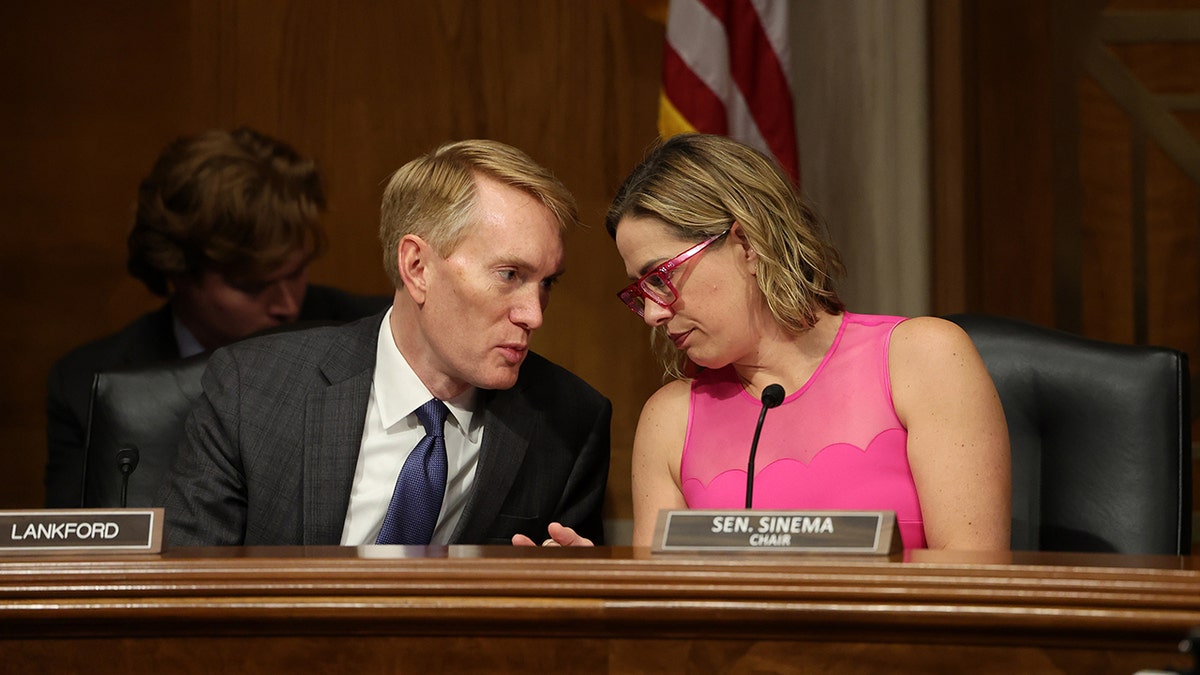
FILE - U.S. Sen. James Lankford (R-OK) talks to Sen. Kyrsten Sinema (I-AZ) talk during a Senate Homeland Security and Government Affairs subcommittee hearing on Sept. 6, 2023 in Washington, DC. It is unclear if the suit will stand or if the court will strike down the morality law on constitutional grounds. (Kevin Dietsch/Getty Images)
Many today would argue that her husband and his deceit caused the harm, not the third party. If a spouse violates their solemn oath of matrimony, the loss of affection is likely due to a breakdown in the marriage, not the third party. The action still has a proprietary element: the "other man" or "other woman" poached a partner who legally belongs to you.
However, the question is whether such "heart balm" injuries remain within the right of states to recognize and allow citizens to recover for. It is technically not a punishment for adultery with the other person, but alienation or harm to the spouse.
Ironically, the case, and any challenges, could represent one of the most lasting legacies of Sinema’s career. The question is not whether her actions were "wicked and malicious" under the common law, but whether you can be sued today for such conduct.
Other torts have changed in light of evolving social values, such as defamation actions that were once based on statements that a woman is "unchaste."
CLICK HERE TO DOWNLOAD THE FOX NEWS APP
While courts have struck down or eliminated morality laws on constitutional grounds, alienation of affection remains a lingering morality tort with strong religious underpinnings. In Proverbs 11:18, the Bible states, "The wicked man does deceptive work, but righteousness brings a sure reward."
The question is whether a "righteous" litigant can still recover from the "wickedness" of others.
Jonathan Turley is a Fox News Media contributor and the Shapiro Professor of Public Interest Law at George Washington University.
He is the author of the new book "Rage and the Republic: The Unfinished Story of the American Revolution" (Simon & Schuster, Feb 3, 2026), on the 250th anniversary of the American Revolution.on the 250th anniversary of the American Revolution.
He is a nationally recognized legal scholar who has written extensively in areas ranging from constitutional law to legal history to the Supreme Court. He has written over three dozen academic articles that have appeared in a variety of leading law journals.
Professor Turley also served as counsel in some of the most notable cases in the last two decades including the representation of whistleblowers, military personnel, former cabinet members, judges, members of Congress, and a wide range of other clients.
Professor Turley testified more than 50 times before the House and Senate on constitutional and statutory issues, including the Senate confirmation hearings of cabinet members and jurists such as Justice Neil Gorsuch. He also appeared as an expert witness in both the impeachment hearings of President Bill Clinton and Donald Trump.
Professor Turley received his B.A. at the University of Chicago and his J.D. at Northwestern. In 2008, he was given an honorary Doctorate of Law from John Marshall Law School for his contributions to civil liberties and the public interest.