By

Camilo Montoya-Galvez
Immigration Correspondent
Camilo Montoya-Galvez is the Immigration Correspondent at CBS News, where his reporting is featured across multiple programs and platforms, including national broadcast shows, CBS News 24/7, CBSNews.com and the organization's social media accounts.
/ CBS News
The Justice Department on Friday issued a legal opinion giving the U.S. military broader powers to detain migrants accused of trespassing in areas that the Department of Defense controls as part of President Trump's crackdown at the southern border.
The opinion from the Justice Department's Office of Legal Counsel concerns large swaths of land near the U.S.-Mexico border that the second Trump administration has designated as "National Defense Areas" for the purposes of deterring illegal immigration.
While the military is generally prohibited from enforcing laws on domestic soil under the longstanding Posse Comitatus Act, the zones have allowed soldiers to detain migrants accused of entering the national defense areas, which are closed to civilians. The arrangement has allowed the Justice Department to prosecute those arrested in the zones for trespassing on military land.
In its opinion Friday, the Justice Department said military personnel can arrest individuals who leave national defense areas before they can be apprehended for trespassing.
"In sum, we conclude that the use of military personnel to arrest trespassers just outside of an NDA would not violate the [Posse Comitatus Act], given the express statutory authorization and the military-purpose of a commander's traditional protective power," Deputy Assistant Attorney General William Hyde said in his opinion.
The Trump administration has so far set up six national defense areas along the southern border, in Arizona, California, New Mexico and Texas. But Friday's opinion said the military has suggested it may designate additional zones in the future.
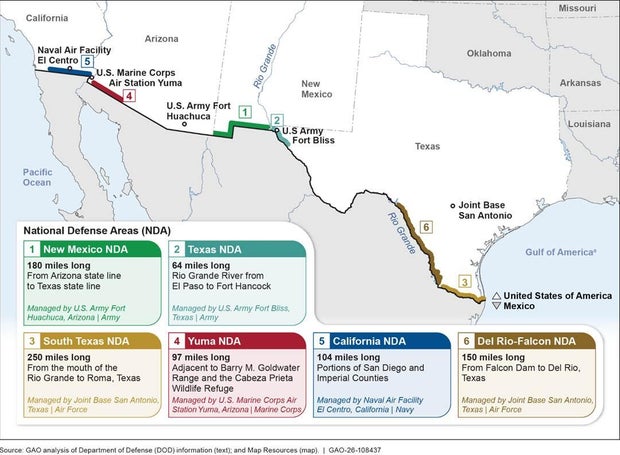
Since the national defense areas encompass wide strips of land that might not appear to be part of a military base, the Defense Department in some areas has put up signs in both English and Spanish warning that the area is restricted and unauthorized entry is prohibited.
U.S. Northern Command, which oversees U.S. military forces in North America, has said on its website that military service members can apprehend those who trespass onto one of the national defense areas and transfer them to the appropriate law enforcement authorities.
The Justice Department began charging individuals who were apprehended in April 2025 and since then has charged hundreds more. The specific charges for trespassing a national defense area are most commonly violating a military security regulation and entering military, naval or Coast Guard property, both of which are misdemeanors. There can also be other charges associated with crossing the border that aren't directly related to trespassing onto military land.
The Pentagon made the U.S.-Mexico border its first mission during the initial days of President Trump's second term by announcing plans to ramp up U.S. forces there. Since then, the Defense Department says more than 20,000 service members have served deployments on the border.
The OLC's legal opinion is advisory only and does not set any legal precedent.
In addition to enlisting the military's help at the southern border, the Trump administration has virtually closed the asylum system for those entering the U.S. illegally. The crackdown has coincided with a dramatic drop in illegal crossings there.
In fiscal year 2025, Border Patrol reported fewer than 240,000 migrant apprehensions along the southern border, down from 1.5 million and 2 million in fiscal years 2024 and 2023, respectively, according to agency data. The number has fallen even more in fiscal year 2026, with Border Patrol recording 81,000 apprehensions, with two months left.
How the U.S.-Mexico border changed since Trump took over
(05:35)