Dalia VenturaBBC News Mundo
It's a tradition repeated in stadiums across the world, with crowds of spectators rising up in a rippling roar.
The largest wave so far, according to Guinness World Records, was at a Nascar racing event in the American state of Tennessee in 2008, when 157,574 people joined a wave that swept around the stadium.
Now, as part of the countdown to the World Cup, Mexico City is attempting to surpass that mark.
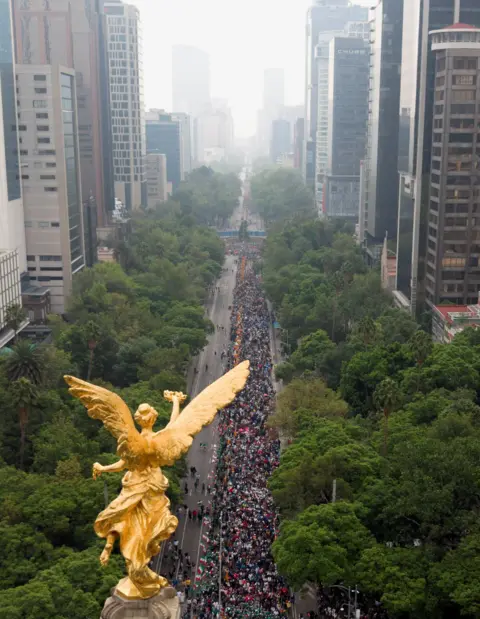
The chosen location was not a stadium, but an urban setting ideal for spreading a visible, continuous wave: the emblematic Paseo de la Reforma, an iconic arterial road inspired by European boulevards.
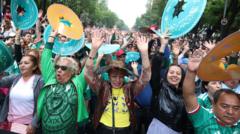
On Saturday, thousands gathered along the avenue and, after several practice runs, made their record attempt.
"Mexico, Mexico!" crowds shouted as they threw their arms in the air, many dressed in the bright green jersey of the Mexican national team.
Guinness officials are now analysing the effort to determine whether a new world record has been set.

 Reuters
The city is a fitting venue: it was here, 40 years ago, that this unique form of collective expression first captured global attention.
Since then, the phenomenon has become closely associated with Mexico.
But many believe George Henderson - or Krazy George - from the US deserves credit for initiating and directing the first ever wave, which is known as the Mexican wave outside North America.
He believes this took place at a baseball game in California in 1981 between the Oakland Athletics and the New York Yankees.
 Getty Images
"The Oakland A's had already lost two away games," he remembers. "In the third inning I thought about trying something no one had seen before. I found three sections and started explaining what I wanted."
The first two attempts failed, but on the third try the wave went all the way around the stadium. And on the fourth, he managed to create a continuous wave.
"The place was going crazy," he says.
Because the game was televised, fans of other sports adopted it.
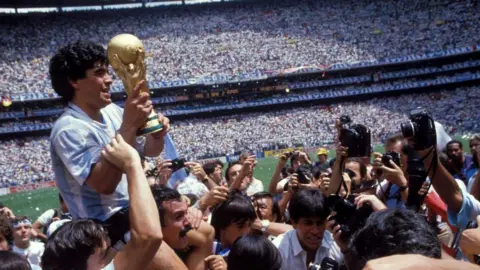
But it was at the Fifa World Cup in 1986 in Mexico that it was broadcast to an enormous global audience - and so became a global phenomenon.
How many people does it take to kick off a wave?
 Getty Images
Fifteen years later, the phenomenon caught the curiosity of a scientist from the statistical and biological physics group at the Hungarian Academy of Sciences in Budapest.
"The reason we became interested in stadium waves is that, apparently, people very often behave like particles," physicist Illes Farkas told the NPR network.
Together with two colleagues, Tamas Vicsek and Dirk Helbing, he set out to determine the rules that produce the wave.
For their research, published in the journal Nature in 2002, the team discovered that a typical human wave travels clockwise and moves at a speed of about 12 metres - or 20 seats - per second.
 Getty Images
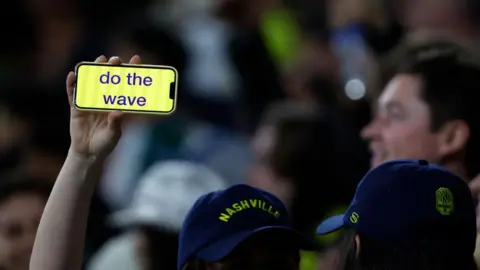
How many people does it take to start a wave? In large stadiums, only 25 to 35 people.
The mathematical model they built to explain this behaviour wasn't new; it was the same one used to describe the spread of a forest fire or the propagation of an electrical signal through heart tissue.
A sign of passion or boredom?
The wave may be universally considered a symbol of collective euphoria - but it can also represent a loss of interest on the part of spectators.
It can suggest a demand for action from the players, and a way of getting something out of the match, Chris Hunt, the author of World Cup Stories, told the BBC.
"When a match drags and nothing interesting is happening on the pitch, fans feel it's a way to make the most of the money they paid for their tickets," he explained.
If the match is a draw in the final minutes of a World Cup final, there will be no wave.
If it's a friendly where the home team is winning emphatically, then there probably will be.