By
/ CBS News
Washington — While President Trump fights in court over his remaking of the John F. Kennedy Memorial Center for the Performing Arts and construction of the White House ballroom, plans for the two Washington institutions are moving ahead.
Now, the latest court filings in those cases are providing a window into the scope of work taking place at the White House on the site of the now-demolished East Room and Mr. Trump's visions for the Kennedy Center.
At the White House, the ballroom project involves millions of pounds of steel and rebar, miles of conduit and a crew of more than 200 working nearly around the clock. And at the Kennedy Center, its board of trustees has advanced a plan to put Mr. Trump's name back on the building following its court-ordered removal and to honor him in at least one other way.
The Kennedy Center
A status report filed Wednesday with the U.S. district court in Washington provides a peek into changes to the performing arts center that its board of trustees agreed last week to undertake.
The board is stacked with Mr. Trump's allies and administration officials, and chaired by the president himself. It voted last week to add Mr. Trump's name to the Kennedy Center's facade, a move that came two months after U.S. District Judge Chris Cooper ruled the board acted unlawfully when it put the president's name on the building last year.
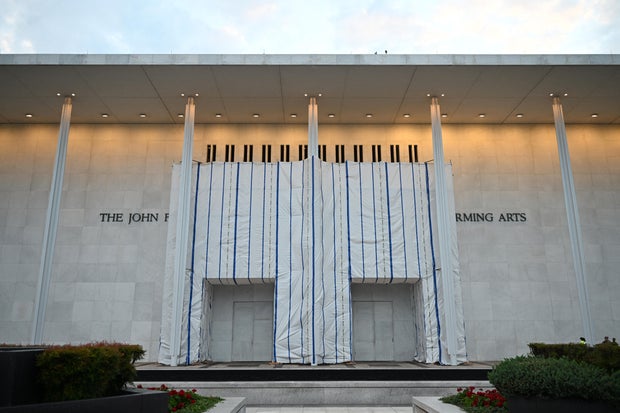
On the heels of that decision, construction crews removed the president's name from the facade overnight on June 13. That area of the center's front portico has been covered by a tarp since then, though, concealing most of its name.
But the board has again taken steps to put Mr. Trump's name back on the front of the Kennedy Center. A resolution approved by the board last week calls for the inscription on the front of the building to read: "The John F. Kennedy Memorial Center for the Performing Arts Restored and Renovated by President Donald J. Trump."
It also requires recognition of the "president's contribution" to the center when the Trump Kennedy Center Fund reaches $100 million. Once that happens, the resolution states that the inscription on the building will read: "The John F. Kennedy Memorial Center for the Performing Arts Restored and Renovated by President Donald J. Trump Endowed by the Trump Kennedy Center Fund."
The board-approved measure also requires the "physical site and grounds" of the Kennedy Center to be named "President Donald J. Trump Plaza."
The board has said it will not implement these changes until Sept. 8 at the earliest.
In the filing, submitted jointly by the Trump administration and lawyers for Rep. Joyce Beatty, an Ohio Democrat who sued last year over the Kennedy Center overhaul, both sides also addressed the tarp in the front of the building.
The Justice Department said the "protective covering" and scaffolding were erected because of water testing and structural repairs to a roof overhang. One portion of that scaffolding was used to remove Mr. Trump's name from the building, government lawyers said.
But they declined to say how long the tarp and scaffolding will remain in place, writing instead that its removal "is contingent upon the scope of any repairs required at present to the marble facade, as well as any other necessary repairs."
They also indicated that the marble may have been damaged.
During removal of Mr. Trump's name, the tarp "served as a safety barrier for ongoing construction activities and helped safeguard the marble facade of the building in light of reported panel damage," Justice Department lawyers wrote.
Beatty's legal team said in the filing that the congresswoman is concerned that the Trump administration may have damaged the marble that lines the center's facade when it affixed Mr. Trump's name to it.
White House ballroom
The White House ballroom has been a fixation of Mr. Trump's for months. But a federal judge considering a legal challenge to the project, brought by the National Trust for Historic Preservation, issued a preliminary injunction in March that would halt construction of the ballroom. U.S. District Judge Richard Leon has allowed below-ground work on national-security facilities to continue.
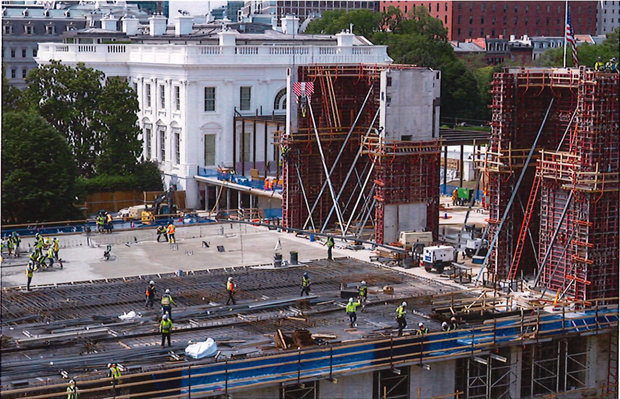
Work above and below-ground has continued, though, as a result of administrative stays — temporary orders — put in place by the district court and a federal appeals court in Washington.
But the Justice Department has now asked the Supreme Court to intervene and freeze the district court's injunction after the U.S. Court of Appeals for the District of Columbia Circuit ruled earlier this month that the White House cannot construct the ballroom without authorization from Congress.
If the high court does not act by Friday, the D.C. Circuit's decision will take effect and construction of the ballroom must be halted.
As part of the Trump administration's request for emergency relief, it submitted a declaration from Joshua Fisher, the director for White House Management and Administration who is overseeing the project, that sheds light on the volume of material being used for the project and the amount of work done already.
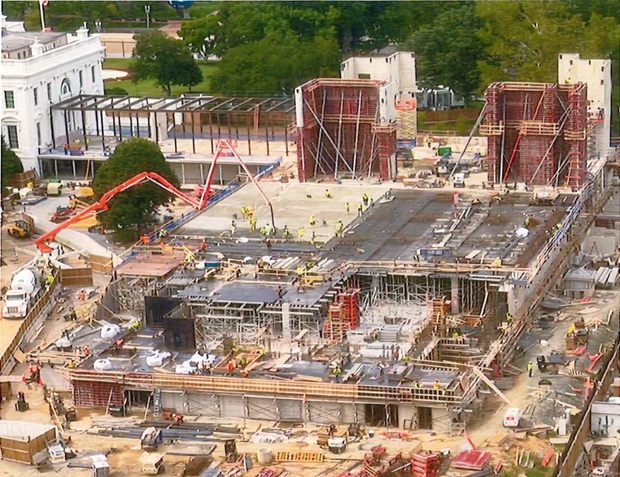
The ballroom is being funded by private donors, and so far, $355 million of $400 million has been raised, according to Fisher. He said a 250-person crew is working 20 hours per day, seven days a week, and 65% of the project is done. Already installed are all below-grade structures, a grand staircase structure, a kitchen structure and a Colonnade movie theater structure, according to the declaration.
The building will be made of concrete and steel, and Fisher said it will be completed by November. The facade is set to be "substantially" finished by April, and the entire project is expected to be wrapped by August 2028, according to Fisher. By then, Mr. Trump will have five months left in his term.
The superstructure has been built up to roof-level, rising up to 70 feet in some places, and has a footprint of 50,000 square feet, Fisher said. The structural foundation, meanwhile, reaches 50 feet below ground.
He provided further details on three major components of the project: the concrete structure, the facades and mechanical, electrical and plumbing.
As to the concrete structure, 6.4 million pounds of rebar has been placed and 18,000 cubic yards of concrete has been poured. Fisher described the concrete as "the hardest and strongest concrete there is, the type used in nuclear power plants — it is impermeable, and virtually impossible to deconstruct."
By Friday, when the district court's injunction takes effect absent Supreme Court action, Fisher said the White House expects to install another 1 million pounds of rebar and pour another 3,000 cubic yards of concrete.
Three million pounds of steel has also been obtained and is being readied for installation, according to Fisher's declaration.
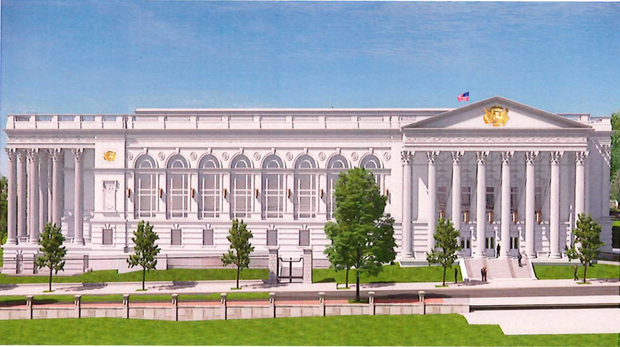
For the facades, the White House has acquired 1 million pounds of steel and 60,000 pounds of aluminum finishes. It has also quarried nearly all of the limestone required, Fisher said. Renderings provided to the Supreme Court show gold-plated presidential seals affixed to the outside of the building.
As to mechanical, electrical and plumbing work, the construction crew has installed five miles of conduit, obtained 1,700 linear feet of plumbing pipe and installed 500 linear feet of that piping.
By Friday, the White House expects to install another mile of conduit and to put in place another 200 linear feet of plumbing pipe.
Mr. Trump's East Wing project will also feature Corinthian columns like those at the Supreme Court. Fisher said the columns at the White House are being made from "the highest-grade" Indiana limestone, which was shipped to Italy, and are being carved "by some of the greatest artists anywhere in the world."
According to the White House, the structure will include bomb shelters; hospital and medical facilities; top-secret military facilities; drone-proof ceilings, walls, windows and roofs; bullet, ballistic and blast-proof glass; and a drone port on top.

Trump asks Supreme Court to intervene in White House ballroom fight
(03:41)