One man's hunger strike changed India's map. Can it still change politics?

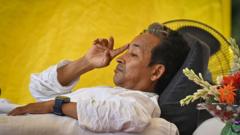
Environmental activist Sonam Wangchuk has survived for 19 days on just salt water at a hunger strike in Delhi
By
India correspondent
It took 58 days without food to change India's map.
When Potti Sriramulu began fasting in October 1952, he was asking for something then prime minister Jawaharlal Nehru had repeatedly resisted: a separate state for Telugu speakers. Sriramulu, a quiet Gandhian who had already undertaken several fasts for social causes, believed only self-sacrifice could force Delhi to listen.
It did.
On the 58th day, Sriramulu died. Crowds poured onto the streets across the Telugu-speaking regions. Government buildings were attacked, railway lines blocked and several reportedly died in the unrest that followed. Days later, Nehru announced the creation of Andhra state. Within a few years came the States Reorganisation Commission and the linguistic remaking of India.
Few individual protests have left such an imprint on the republic. "Potti Sriramulu is a forgotten man today. This is a pity, for he had a more than minor impact on the history, as well as geography of his country," historian Ramachandra Guha has written. One man's empty stomach had helped redraw the world's largest democracy.
That may also explain why, more than seven decades later, Indians continue to reach instinctively for the hunger strike. The latest reminder is educationist and climate activist Sonam Wangchuk, whose indefinite fast has prompted growing concern over his rapidly deteriorating health.
The 59-year-old has survived for 19 days on salt water alone, losing more than 9kg while protesting in support of an online satirical movement, the Cockroach Janta Party (CJP), which is demanding education reforms. As calls mount for him to end his fast, the Delhi High Court has ordered the government to monitor Wangchuck's health and provide treatment if needed.

Mahatma Gandhi fasts in protest against British rule after his release from prison in India in 1948
No country has woven fasting into its political life quite like India. Elsewhere, protesters block roads or hold marches. Indians do those things too. But they also stop eating.
The practice predates the republic by centuries. Hinduism, Buddhism and Jainism all attach moral significance to voluntary self-denial. Mahatma Gandhi, the leader of India's independence movement, took that ancient language and transformed it into modern politics. A fast, he insisted, was not blackmail but an act of suffering intended to awaken rather than coerce.
Between 1918 and his assassination in 1948, Gandhi fasted repeatedly - against religious violence, caste discrimination and political discord - turning the empty plate into one of the defining symbols of India's freedom struggle. By one estimate, Gandhi undertook at least 15 major fasts. His longest lasted 21 days, external; his final fast, in January 1948, lasted five days and helped restore communal peace in Delhi.
"Fasting is his last resort in the place of the sword," Gandhi wrote, external in 1948, on the eve of his last fast.
When the charismatic leader went on a fast in Calcutta (now Kolkata) to stop bloody religious rioting in 1947, the British-owned Statesman newspaper noted: "On the ethics of fasting as a political instrument we have over many years failed to concur with India's most renowned practitioner of it... But never in a long career has Mahatma Gandhi, in our eyes, fasted in a simpler, worthier cause than this, not one calculated for immediate effective appeal to the public conscience."
Independent India inherited the habit. There have been hunger strikes demanding farmers' rights, affirmative action, environmental protections, anti-corruption laws and the repeal of controversial security legislation.

Irom Sharmila refused food for 16 years, surviving only because authorities force-fed her through a nasal tube
Activist Anna Hazare's 13-day fast in 2011 gave fresh momentum to an anti-corruption campaign that briefly captured the national imagination. Irom Sharmila, protesting against the draconian Armed Forces (Special Powers) Act in India's north-east, refused food for 16 years, surviving only because authorities force-fed her through a nasal tube. Medha Patkar, a prominent social activist, has repeatedly undertaken prolonged hunger strikes to demand fair compensation and rehabilitation for people displaced by big dam projects.
"Hunger strikes are a global form of protest, not uniquely Indian," says Sayantan Saha Roy, an anthropologist at the University of Connecticut whose recent research explores the politics of fasting.
To be sure, across the British Empire, the hunger strike emerged as a shared language of democratic, anti-colonial resistance - embraced by suffragettes in Britain and nationalists in Ireland and India.
"But in India, where governments can become deeply unresponsive, protesters often see fasting as the only way to force those in power to act," says Saha Roy.
India, he says, has a particularly rich tradition of the hunger strike because Gandhi transformed it into an enduring moral and political act. "In a world of self-interested politics, they stand out as acts of self-sacrifice. As the protester's body weakens, the moral and political pressure on those in power grows."
That pressure, however, depends on an audience. "Hunger strikes have to be performative to be persuasive. They're not just aimed at the state, but at the public, whose outrage can pressure those in power," Saha Roy says.
He points to the Irish hunger strikes in the 1970s and 80s as an example. "These protesters [Irish republicans demanding to be treated as political prisoners instead of criminals] were trying to mobilise the Irish public through a vivid demonstration of their suffering and by embracing their death. The body of the hunger striker then becomes a demonstration of the cruelty of the state.
"But there's no guarantee the audience will respond, which is what makes hunger strikes such a precarious form of protest."

Anna Hazare's fast in 2011gave fresh momentum to an anti-corruption campaign that briefly captured the national imagination
For all their moral power, however, hunger strikes have never been beyond criticism.
If Gandhi elevated the hunger strike into a moral weapon, BR Ambedkar, one of India's greatest statesmen, was deeply sceptical of it in independent India.
In a landmark speech in 1949, he argued that once constitutional avenues existed, methods such as fasting and civil disobedience should give way to democratic processes, warning that otherwise they became the "grammar of anarchy". "The sooner they are abandoned, the better for us," he said.
That debate has never really gone away. In recent years, critics have continued to question whether fasting unto death belongs in a constitutional democracy.
Writing during Anna Hazare's anti-corruption fast in 2011, political philosopher Pratap Bhanu Mehta argued , externalthat such protests can become "deeply coercive". When it is tied to "an unparalleled moral eminence", he wrote, a fast unto death "amounts to blackmail".
Public scepticism has grown accordingly. Social media fills with jokes about politicians sneaking meals behind closed doors or breaking their "fasts" with lavish feasts. Some fasts last only hours; others are carefully staged media spectacles with banners, platforms and live television coverage.
In other words, not every empty stomach carries the same political weight - and history seems to bear that out.
Sriramulu's death reshaped the Union itself. Hazare's protest briefly galvanised a nationwide anti-corruption movement before its momentum quickly faded. Sharmila became an international symbol of resistance, even if the law she opposed remained in place.

Striking pilots hold placards during a hunger strike in Delhi in 2012
Doctors, meanwhile, are often uneasy participants in these dramas. After two weeks without food, the body begins breaking down muscle as well as fat. Electrolyte disturbances can trigger fatal heart rhythm problems. Reintroducing food too quickly carries its own dangers. Every prolonged fast therefore unfolds simultaneously as a political protest and a medical emergency.
Governments know this too: force-feeding hunger strikers is common after taking them to hospital. As Wangchuk has grown visibly frailer, opposition leaders, activists, artists and musicians have already urged him to end his fast.
Yet despite the cynicism, India has never quite abandoned the idea that voluntary suffering can move politics in ways speeches cannot.
Wangchuk's fast appears to follow the same script. "In the public demonstration of his suffering, Wangchuk seems to be following Gandhi's path," says Saha Roy. "As his health deteriorates, his protest gains traction and raises the political stakes for the government. How this unfolds remains to be seen."
Whether Wangchuk's empty stomach ultimately changes minds - or simply joins the long roll call of sacrifices that failed to do so - may determine not only the fate of his protest, but also the enduring power of one of India's oldest political rituals.