Just after Secretary of Defense Pete Hegseth and Gen. Dan Caine, the chairman of the Joint Chiefs of Staff, said on Wednesday that the Strait of Hormuz had reopened in accordance with a ceasefire agreement, Iran said it had closed the passage and accused Israel of violating the deal.
A major part of the two-week ceasefire agreement reached Tuesday night -- just hours before Trump's deadline to respond to his threat to annihilate a "whole civilization" if Iran didn't make peace -- requires Iran to reopen the vital passage for trade and oil to international shipping before peace talks can begin.
But after allowing a handful of ships, including two oil tankers, to pass through the Strait of Hormuz on Wednesday, Iran said it had closed the strait, accusing Israel of violating the ceasefire by launching a major attack on Lebanon, Iran's Far News agency, which is affiliated with the Islamic Revolutionary Guard Corps (IRGC), reported.
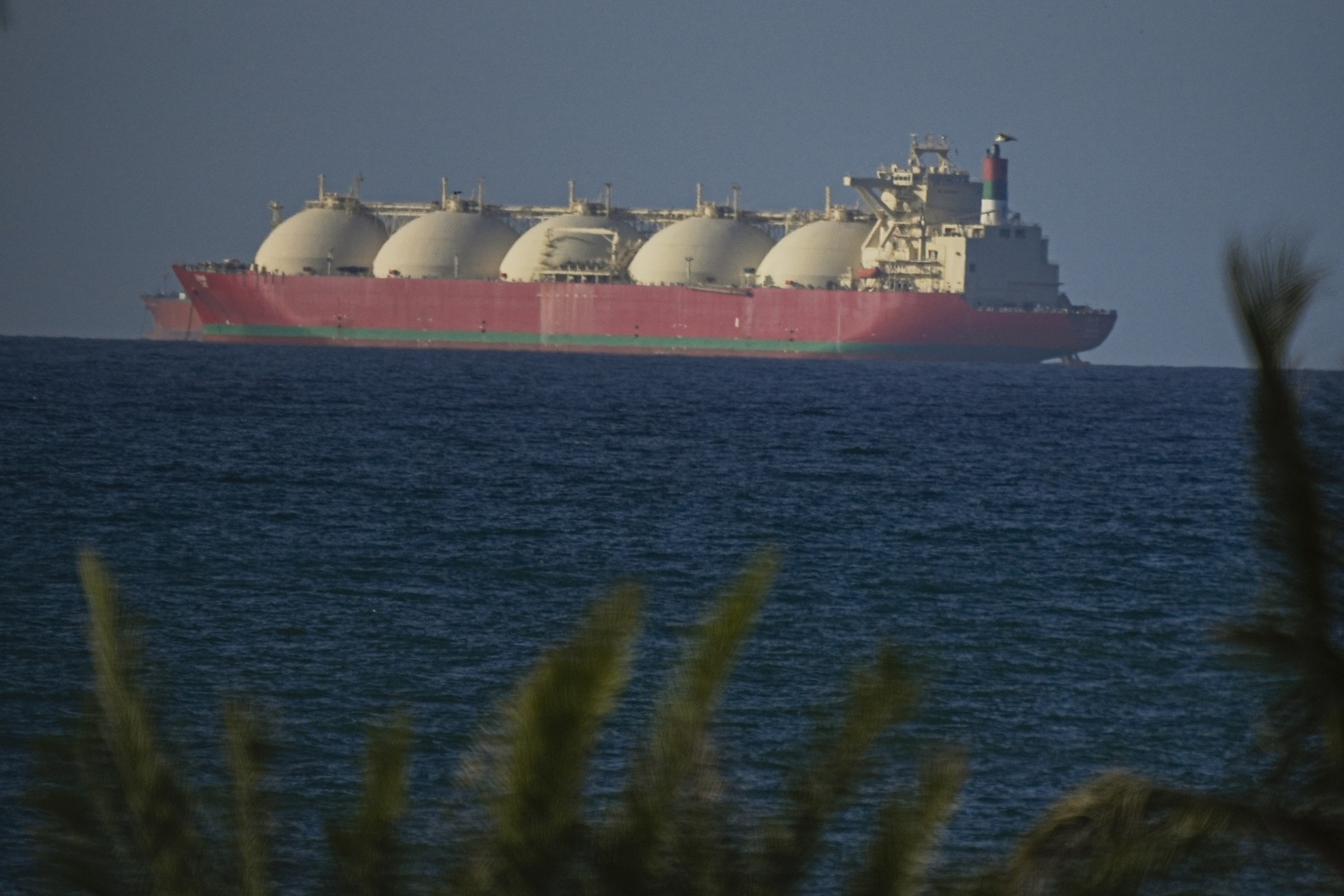
A view of the vessels passing through the Strait of Hormuz following the two-week temporary ceasefire reached between the United States and Iran on the condition that the strait be reopened, seen in Oman, April 08, 2026.
Anadolu via Getty Images
"The Iran-U.S. Ceasefire terms are clear and explicit: the U.S. must choose -- ceasefire or continued war via Israel. It cannot have both," Abbas Araghchi, Iran's Foreign Minister, said in a social media post. "The world sees massacres in Lebanon. The ball is in the U.S. court, and the world is watching whether it will act on its commitments."
Araghchi attached a social media post from Pakistan Prime Minister Shehbaz Sharif, highlighting a section, saying, Iran and the United States "have agreed to an immediate ceasefire everywhere, including Lebanon."
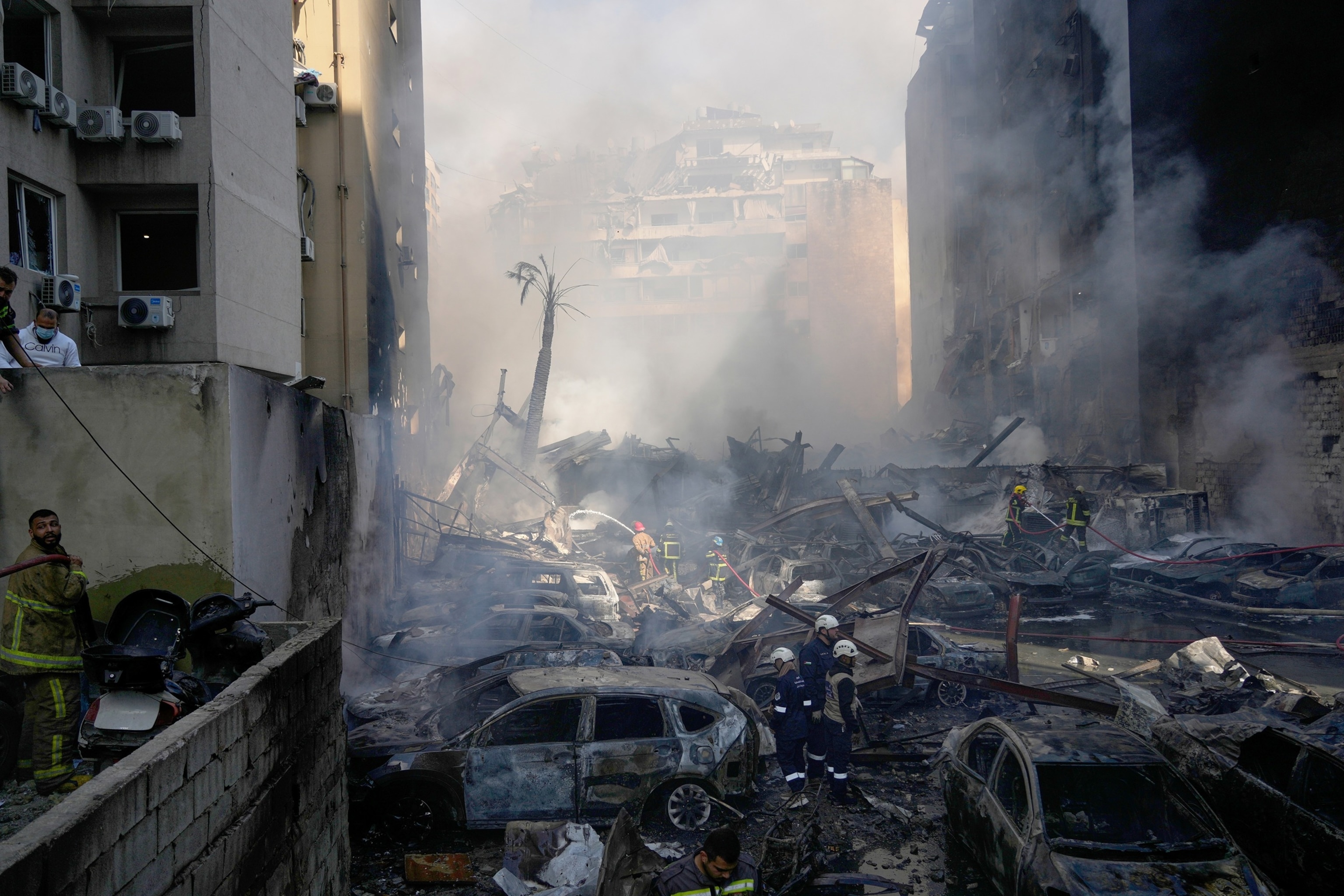
Firefighters spray smoldering debris at the site of an Israeli airstrike that struck a building in Beirut, Lebanon, April 8, 2026.
Hassan Ammar/AP
The Islamic Revolutionary Guard Corps (IRGC) warned Israel and the United States on Wednesday that if attacks on Lebanon do not stop, it will retaliate and deliver a "regretful response."
Sharif, who helped broker the ceasefire deal, posted another statement on social media on Wednesday following Israel's attack on Lebanon, saying, "Violations of [the] ceasefire have been reported at few places across the conflict zone, which undermine the spirit of the peace process."
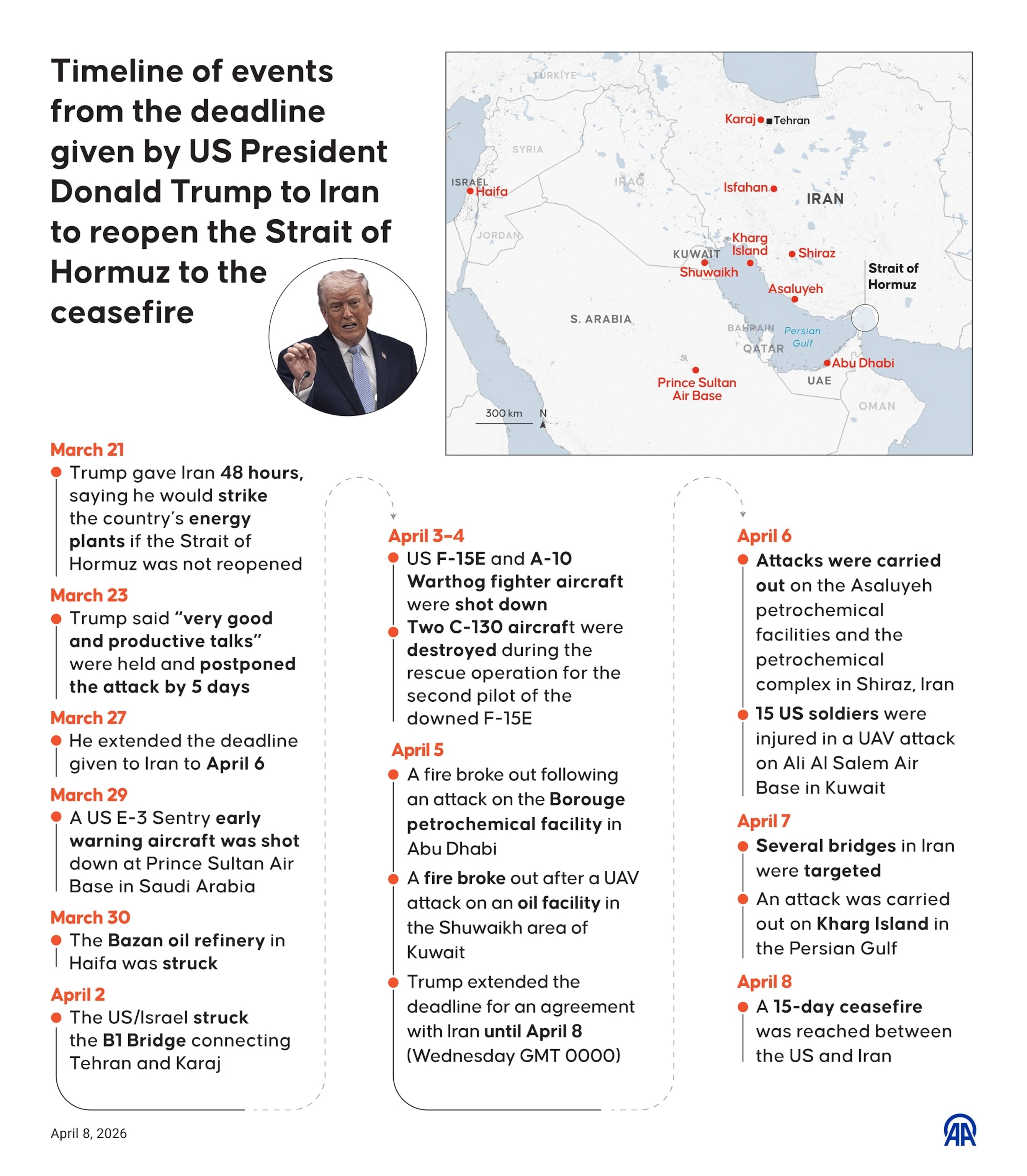
Timeline of events from the deadline given by President Donald Trump to Iran to reopen the Strait of Hormuz to the ceasefire agreement reached on April 7, 2026.
Anadolu via Getty Images
Sharif, who did not specify where the violations took place, added: "I earnestly and sincerely urge all parties to exercise restraint and respect the ceasefire for two weeks, as agreed upon, so that diplomacy can take a lead role towards peaceful settlement of the conflict."
During a phone interview on Wednesday with PBS, President Donald Trump said that Lebanon was not included in the ceasefire agreement, noting that Hezbollah, Iran's proxy, has launched attacks on Israel from Lebanon.
White House press secretary Karoline Leavitt also said during a press briefing Wednesday: "Lebanon is not part of the ceasefire. That has been relayed to all parties involved in the ceasefire."
Iran's Parliament Speaker Mohammad Bagher Ghalibaf also accused the United States of violating the proposed framework of the ceasefire laid out in Iran's 10-point peace proposal.
Ghalibaf specifically accused the U.S. of violating three of its proposals, including Israel's Wednesday attack on Lebanon, violating Iran's airspace with an "intruding drone" and denying Iran's right to enrich uranium.
"The deep historical distrust we hold toward the United States stems from its repeated violations of all forms of commitments a pattern that has regrettably been repeated once again," Ghalibaf said in a statement.
Earlier on Wednesday, Hegseth said, "What has been agreed to, what has been stated is that the strait is open."
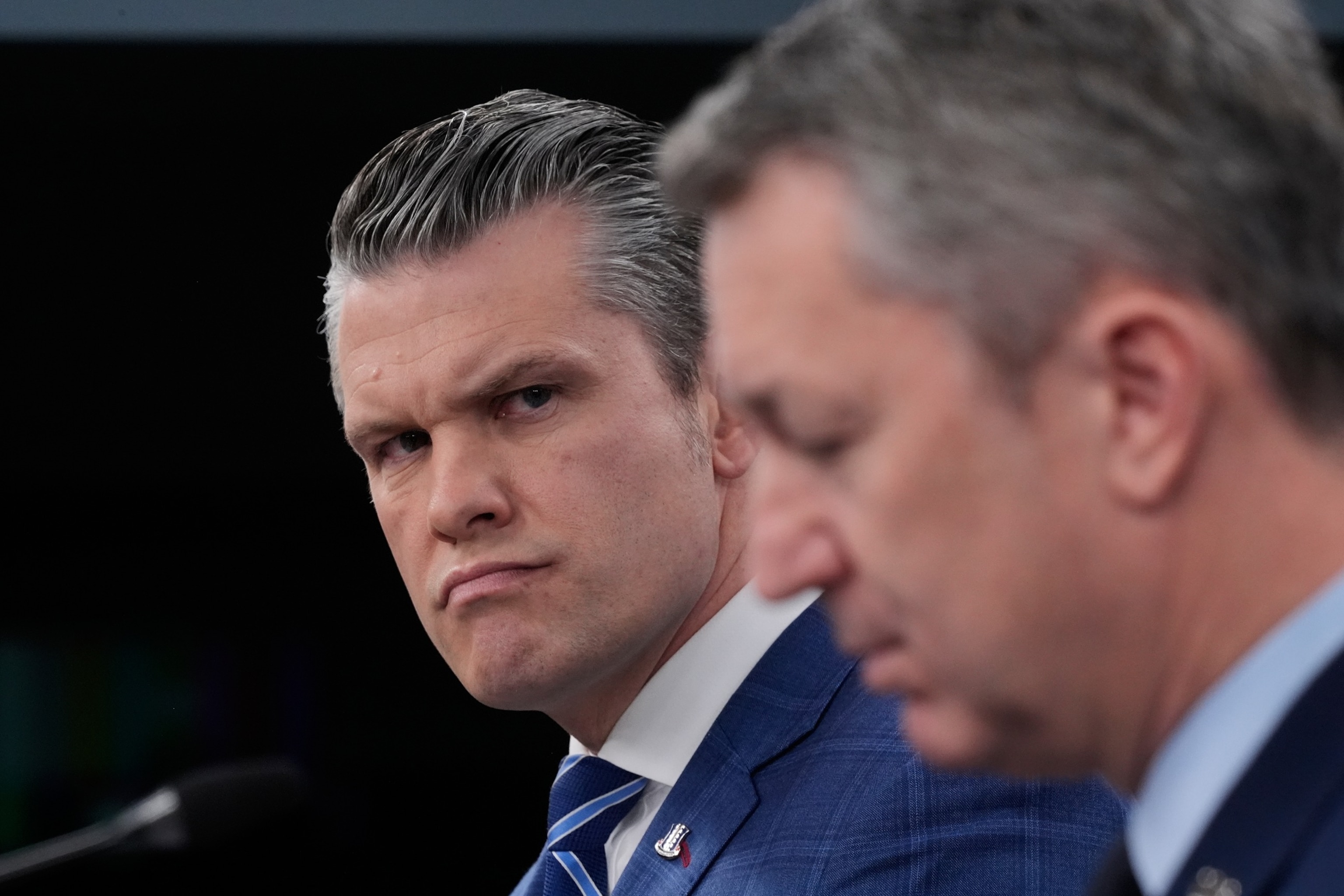
Defense Secretary Pete Hegseth looks toward Chairman of the Joint Chiefs of Staff Gen. Dan Caine, as they speak to members of the media during a press briefing at the Pentagon in Washington, April 8, 2026.
Manuel Balce Ceneta/AP
"Our military is watching. I'm sure their military is watching, but commerce will flow, and that's what you saw the markets react to is that reality," Hegseth said.
In response to a question from ABC News during a Pentagon briefing Wednesday morning on whether the strait is open, Caine added, "I believe so based on the diplomatic negotiation."
Trump said late Tuesday in a post on his social media platform that Iran had agreed to a "COMPLETE, IMMEDIATE, and SAFE OPENING of the Strait of Hormuz." In a separate post, Trump said, the U.S. "will be helping with the traffic buildup in the Strait of Hormuz."
Popular Reads
Hegseth noted that the United States depends very little on the strait to transport oil.
"It's time for the rest of the world to step up and ensure that that stays open, after President Trump and the War Department brought Iran to the place where they are voluntarily opening it right now, and was announced last night," Hegseth said of the strait.

A first responder emerges through the smoke at the site of an Israeli airstrike that struck an apartment building in Beirut, Lebanon, April 8, 2026.
Bilal Hussein/AP
In a statement Tuesday night, Araghchi said Iran agreed to a ceasefire and presented the United States with a 10-point counterproposal as a "general framework" for a peace agreement.
"If attacks against Iran are halted, our Powerful Armed Forces will cease their defensive operations," Araghchi said. "For a period of two weeks, safe passage through the Strait of Hormuz will be possible via coordination with Iran's Armed Forces and with due consideration for technical limitations."
Araghchi did not elaborate on the "technical limitations," but Hegseth said on Wednesday that Iran's "command and control is so decimated they can't really talk and coordinate."
During a news conference in Hungary on Wednesday, Vice President JD Vance described the ceasefire as a "fragile truce."
"The Iranians have agreed to open up the strait. The United States has agreed to stop attacking, and ... not just the United States, but also our allies have agreed to stop attacking," Vance said.
Ed Finley-Richardson, a shipping investment analyst for Contango Research, told ABC News that prior to Iran claiming Israel violated the ceasefire and closing the Strait of Hormuz, shipowners were "optimistic enough to make serious preparations to exit the Strait."
"The overnight news from both Washington and Tehran created an atmosphere of hope, for the first time since the war started. The optimism was such that charterers started working on new cargo loadings, the first from within the gulf scheduled since the war started," Findley-Richardson said.
He added, "All of that fell apart when Iran deemed that the ceasefire had been violated. However, clearly the conditions are ripe for at least a partial resumption of shipping traffic."
Before Iran said it closed the strait once again, the Danish shipping company Maersk, one of the largest container shipping companies in the world, said in a statement to ABC News that the ceasefire "may create transit opportunities, but it does not yet provide maritime certainty."
Maersk said information about the ceasefire remained "very limited" and that it needed "further clarity" before sending ships through the Strait of Hormuz.
"The safety of our seafarers, vessels and cargo remains Maersk's highest priority," the company said. "Any decision to transit the Strait of Hormuz will be based on continuous risk assessments, close monitoring of the security situation, and available guidance from relevant authorities and partners."