Live
By
Tucker Reals
Editor
Tucker Reals is CBSNews.com's foreign editor, based in the CBS News London bureau. He has worked for CBS News since 2006, prior to which he worked for The Associated Press in Washington, D.C., and London.
/ CBS News
What to know about the Iran war today:
- Secretary of State Marco Rubio said Friday that indirect negotiations over a potential deal to end the U.S.-Israeli war with Iran had seen "a little bit of movement, and that's good."
- Rubio tempered expectations for a peace agreement, however, alluding to unresolved differences over Iran's nuclear enrichment, and Tehran's effort to "create a tolling system" in the Strait of Hormuz, which he called "not acceptable."
- President Trump said earlier this week that he was willing to wait "a couple of days" for an Iranian response to the latest American offer, but he warned that "we have to get the right answers" to avoid a return to war.
Lebanon's army insists soldiers loyal after U.S. sanctions one over alleged Hezbollah links
Lebanon's military said Friday its soldiers were loyal, after the U.S. announced sanctions that included, for the first time, an army officer accused of sharing information with the Iranian-backed group Hezbollah.
In a statement, the army said it "affirms that all officers and members of the military institution are performing their national duties with utmost professionalism, responsibility, and discipline, in accordance with the decisions and directives issued by the army command."
It emphasized "the loyalty of military personnel is solely to the military institution and the nation, and that they are committed to fulfilling their national duties without any other considerations or pressures," adding that it had not been informed of the U.S. sanctions beforehand.
The Trump administration announced sanctions Thursday against what it called nine Hezbollah-linked individuals in Lebanon, including Army Colonel Samir Hamadi, and Khattar Nasser Eldin, an officer with another state security service.
The U.S. said Hamadi and Nasser Eldin had "shared important intelligence" with Hezbollah over the past year.
It marked the first time Lebanese officers have been sanctioned by the United States.
Hezbollah on Thursday condemned the sanctions, calling them "an attempt to intimidate the free Lebanese people in order to bolster the Zionist aggression against our country."
Israel and Lebanon signed a ceasefire on April 17, but Israel has continued to launch strikes, carry out demolitions and issue evacuation orders in southern Lebanon, saying it is targeting Hezbollah, which has also kept up attacks and described the ceasefire as "appeasement."
CBS/AFP
"Let's see if the United Nations still works," Rubio says as Security Council considers Strait of Hormuz resolution
Secretary of State Marco Rubio said Friday that it "would be lamentable" if a United Nations Security Council resolution on the Strait of Hormuz didn't pass, adding: "Let's see if the United Nations still works."
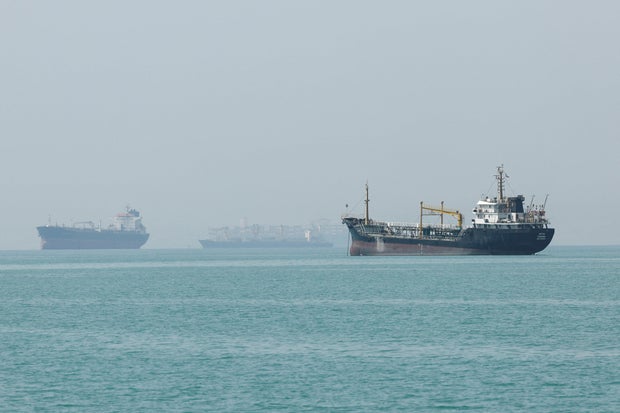
The draft resolution, tabled by Bahrain, calls on Iran to immediately stop its attacks and threats against vessels in the strait and to end attacks on Persian Gulf states. It also addresses the placement of sea mines in the vital waterway, and Iran's efforts to impose tolls on commercial ships using the strait.
Speaking to journalists ahead of a meeting of NATO foreign ministers in Sweden, Rubio said the draft resolution had "the highest number of co-sponsors of any resolution ever" at the council, the UN body tasked with maintaining peace and security through legally binding resolutions.
"Unfortunately, a couple of countries on the Security Council are thinking about vetoing it," he added. "That would be lamentable."
A similar resolution, also tabled by Bahrain, was vetoed last month by China and Russia, which, like the U.S. and the council's two other permanent members, can unilaterally block a measure.
"We are doing everything we can though to achieve the sort of global consensus that's necessary to prevent this from happening," said Rubio. "Let's see if the United Nations still works."
He said "almost every country represented here today" had co-sponsored the resolution, "and if they haven't, I'm sure they soon will because I don't know of anyone in the world … that should be in favor of a tolling system in an international waterway."
Iran's Ambassador Amir Saeid Iravani told reporters in early May that the draft was "deeply flawed, and one-sided."
Saeid argued the solution to the crisis in the strait is a permanent end to the U.S.-Israeli war with his country, and the U.S. blockade of Iranian ports and vessels.
Rubio says Iran charging for Strait of Hormuz passage "not acceptable"
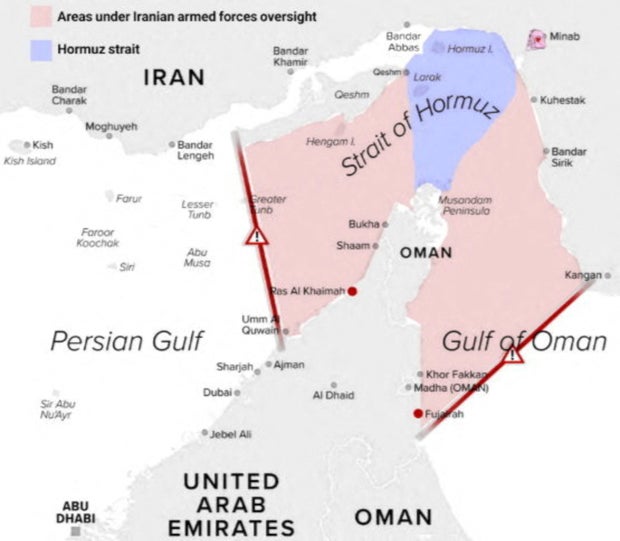
Rubio said "there is not a country in the world that should accept" Iran's effort to "create a tolling system" to charge commercial vessels a fee to transit the Strait of Hormuz.
The narrow waterway – through which about a fifth of the global oil supply typically passed prior to the U.S. and Israel launching their joint war with Iran — was open to all ships until the conflict began. Tehran has said it is working in conjunction with Oman, the other nation with a coastline in the strait, "to develop a mechanism" to ensure "transit through the Strait of Hormuz is conducted in the safest possible manner."
Oman has not confirmed the nature of any coordination with Iran on such a new system.
Rubio said Tehran was "trying to convince Oman" to join "in this tolling system in an international waterway."
"That's just not acceptable. It can't happen," Rubio said of any Iranian bid to impose regularized demands for payment for ships' passage. "If that were to happen in the Straits of Hormuz, it will happen in five other places around the world."
A senior Iranian official argued in a news article published on Thursday that Iran, as a coastal nation of the waterway, was within its rights to impose new restrictions on ships using the Strait of Hormuz due to a "fundamental change of circumstances" brought about by the U.S.-Israeli war launched almost three months ago.
Rubio says "slight progress" in talks with Iran is good, as U.S. awaits Tehran's response to latest proposal
Secretary of State Marco Rubio said Friday that the U.S. was still waiting for Iran to respond to the Trump administration's latest terms for a potential peace deal, which were conveyed this week via Pakistani mediators. Tehran confirmed Thursday that it was considering the proposal.
"We await word on those conversations that are ongoing. There's been some slight progress," Rubio told reporters in Sweden, where he is attending a NATO summit. "I don't want to exaggerate it, but there's been a little bit of movement, and that's good."
"The fundamentals remain the same," he said of the latest U.S. offer. "Iran can never have a nuclear weapon. It just cannot. This regime can never have nuclear weapons, and to achieve that, we're gonna have to address the issue of enrichment. We're gonna have to address the issue of the highly enriched uranium. And then added to this, of course, is the issue of the strait."
U.S. "doing a pause" in $14 billion arms sale to Taiwan over Iran war, Navy's acting secretary says
The acting secretary of the U.S. Navy said Thursday that arm sales to Taiwan had been put on "pause" to ensure that the American military had sufficient munitions for its Iran operations.
Asked at a congressional hearing about the stalled $14 billion weapons purchase by Taiwan, Acting Secretary Hung Cao said that "right now we're doing a pause in order to make sure we have the munitions we need for Epic Fury — which we have plenty."
"But, we're just making sure we have everything, then the foreign military sales will continue when the administration deems necessary."
The State Department and the Pentagon did not immediately respond to requests for comment on Cao's remarks.
President Trump hasn't committed to following through with the sale, raising concerns over his commitment to support for Taiwan, which China claims as its own territory.
CBS/AFP
House Republicans call off vote on Iran war resolution that appeared to have enough support to pass
Republicans struggled Thursday to find the votes to dismiss legislation that would compel President Trump to withdraw from the war with Iran, delaying planned votes on the matter into June.
The House had scheduled a vote on a war powers resolution, brought by Democrats, that would rein in Trump's military campaign. But as it became clear that Republicans would not have the numbers to defeat the bill, GOP leaders declined to hold a vote on it. It was the latest sign of the slipping support in Congress for the war that Mr. Trump launched more than two months ago without congressional approval.
"We had the votes without question and they knew it, and as a result they're playing a political game," said Democratic Rep. Gregory Meeks, who sponsored the bill.
"The Republican-controlled House continues to behave like a wholly-owned subsidiary of the Trump administration," House Democratic leaders said in a joint statement. "Republicans cowardly pulled a scheduled vote on a War Powers Resolution—legislation that would have passed with bipartisan support and required the President to end the conflict in the Middle East."
Republicans in the Senate are also working to ensure they have the votes to dismiss another war powers resolution that advanced to a final vote earlier this week, when four GOP senators supported the resolution and three others were absent from the vote.
The actions by congressional leaders showed Republicans are struggling to maintain political backing for Mr. Trump's handling of the war. Rank-and-file Republicans are increasingly willing to defy the president over the conflict.
House Republican Leader Steve Scalise told reporters that the vote was delayed to give lawmakers who were absent a chance to vote. House Speaker Mike Johnson did not answer questions from reporters as he exited the House chamber.
CBS/AP
Israeli military says strike killed 2 in south Lebanon
The Israeli military says it carried out an airstrike in south Lebanon Friday that killed two people who were armed and "moving in a suspicious manner" in an area where it's fighting Hezbollah.
Israel and the Iran-backed group have been regularly trading fire in the country's south despite a ceasefire that was extended by Israeli and Lebanese authorities last week.
"A short while ago, IDF surveillance identified two armed individuals moving in a suspicious manner hundreds of meters from Israeli territory, in southern Lebanon," the Israeli military posted on Telegram.
"Following their identification and continuous monitoring by the IDF, the armed individuals were struck and eliminated in an aerial strike," the post said.
Lebanon's state-run National News Agency (NNA) reported overnight strikes in the southern Tyre district killed four and wounded two medics at an Islamic Health Committee site.
Since an Israel-Lebanon truce began on April 17, Israel has continued to launch strikes, carry out demolitions and issue evacuation orders in south Lebanon, saying it is targeting Hezbollah, which has also kept up attacks.
Iraq condemns attacks allegedly launched from within country on UAE, Saudi Arabia
Iraq's prime minister condemned alleged attacks launched from within its borders on Saudi Arabia and the United Arab Emirates.
The UAE said on Tuesday a drone that hit a nuclear plant was launched from within Iraq, while the Saudis said they intercepted three drones entering their airspace from Iraq.
Iraqi Prime Minister Ali Faleh Al-Zaidi said Thursday the country was renewing its "condemnation and renunciation" of the attacks and pledged a joint investigation of both strikes with the UAE and Saudi Arabia.
"We express our rejection of the use of Iraqi territory or airspace as a launching ground for attacks against brotherly and friendly states, and reaffirm Iraq's role as a meeting point for shared interests," Al-Zaidi said on X.
There are several Iran-backed militias operating in Iraqi territory separate from the Iraqi government.
In: