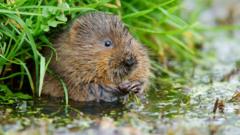
'Squashed poo' a sign of water voles' success

Droppings, burrows and chewed vegetation are all signs of water vole population recovery
ByFiona Irving
South East environment correspondent
"I've never been so excited to see a poo," says urban rewilding officer Pia Trevelyan-Ashby.
She holds out a small Tic Tac-shaped dropping from a water vole and smiles. "This is what success looks like."
She has been on the hunt for evidence of the water vole population in the Hogsmill River in Surrey.
One year ago, South East Rivers Trust and environmental organisation Citizen Zoo released 42 water voles into the chalk stream.
Now, all the signs point to a population of water voles that has not only survived the winter, but is thriving.

Pia Trevelyan-Ashby says water voles populations drop by about 80% over the winter
The water vole project works in tandem with another river trust scheme, which sees teams working with the Waterlife Recovery Trust to eradicate the mink population from Surrey.
Laura Nee, catchment officer for the South East Rivers Trust, said the non-native species "predate on about one animal per day".
"By removing one mink from the ecosystem you're then protecting all those species such as water voles," she told the BBC.
Water voles are also threatened by habitat destruction.
The UK has lost as much as 90% of its water vole population since the 1970s, according to the International Union for Conservation of Nature.

Laura Nee says conservationists are trying to eradicate the mink whilst reintroducing water voles
Trevelyan-Ashby says she spends an "abnormal amount of time looking for poo", but says it is the best way of getting an indication of how the rodent's population is doing.
Citizen Zoo has also set up camera traps and "latrine rafts" - floating rafts where the water voles defecate - to help gather evidence of the population on the Hogsmill.
Recent surveys found signs that water voles had established themselves both upstream and downstream of the original release site.
Trevelyan-Ashby says water voles help keep vegetation in "good shape" and, because they are at the bottom of the food chain, they are food for lots of other species, and an "essential part" of a "healthy, dynamic ecosystem".

The water vole has distinctive Tic Tac shaped droppings
Along with the droppings and camera trap evidence, burrows in the mud bank are also a good indication of the population.
"We're finding more and more burrows every time we come," said Trevelyn-Ashby.
At the entrance of a little hole in the muddy river bank she points to a patch of dark brown in the lighter coloured mud.
It is another sign of water vole activity - squashed poo.
This is an "active burrow", the conservationist said, explaining that the water voles have been "mushing" their droppings.
The rodents have scent glands on their feet and trample on their droppings to mark their territory.

A total of 42 water voles were released into Chamber Mead wetlands and the adjacent Upper Hogsmill River in July 2025
Water voles use to be fairly common in the Hogsmill River catchment but the species, immortalised as Ratty in The Wind in the Willows, was "locally extinct" until 2025.
The Hogsmill release last year marked the return of the rodent to the county after an absence of more than 20 years.
Nee says the continued presence of the water voles is a sign the river is looking healthier.
"It shows that we've got enough vegetation, we have this more naturalised bank," she said.
Follow BBC Surrey on Facebook, external, on X, external, and on Instagram, external and listen to BBC Radio Surrey on Sounds. Send your story ideas to southeasttoday@bbc.co.uk, external or WhatsApp us on 08081 002250.