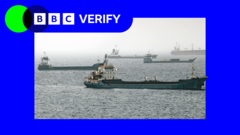
Leaving the Sea of Azov is not necessarily a guarantee of safety from Ukraine's drone strikes.
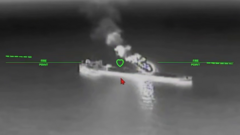
Ukraine's general staff released footage on Wednesday of a naval drone attack on a sanctioned tanker called Blue.
The onboard footage shows the unmanned vessel evading fire as it approaches the tanker, before the video cuts out as it approaches the ship's hull.
Although the location cannot be confirmed, Ukraine said the incident occurred near Yalta, a Black Sea resort city in occupied Crimea.
The tanker attacks coincide with continued strikes on Russian oil refineries, which have caused widespread fuel shortages across the country including in Moscow and St Petersburg.
Ukrainian President Volodymyr Zelensky has argued that by targeting oil refineries Kyiv is rightly responding to Russia's strikes and that Russians must "feel that it is their state that is waging war".
He highlighted two further attacks on oil depots, in the Tver and Stavropol regions hundreds of kilometres from the front line, as well as an unnamed oil terminal in Rostov region, believed to be Yug Rusi, inland from Taganrog Bay.
US President Donald Trump described the drone strategy as an escalation when he met Zelensky at the Nato summit in Ankara on Tuesday, "but it's also an escalation that can help lead to an end".
But it is the scale of drone attacks on Russian maritime logistics that appears to have intensified in recent days.
Brovdi claimed attacks on 12 tankers in just one night from Wednesday into Thursday, and Russian pro-war sources have not questioned either the details or the authenticity of the footage.
The "Military Informant" Telegram channel complained that the defenseless manner in which the tankers had travelled had become in effect a shooting gallery for Ukrainian drone operators, with no cover from a Black Sea Fleet, which could nowadays barely defend itself.
Mikhail Zvinchuk, author of the Telegram channel "Rybar" pointed out that the Black Sea Fleet had "now shut itself in at Novorossiysk".
These strikes will come as painful blow given declining oil refining capacity and fuel shortages, in Crimea especially.
In late June, Vladimir Putin estimated Crimea's monthly fuel needs at 70,000 tons and promised to secure supplies to the peninsula by increasing deliveries by both land and sea. The tankers attacked in the Sea of Azov may well have been carrying considerably more than that.
There is now fuel rationing or shortages in more than 90% of Russian regions, and Russia has now banned exports of diesel. Queues are reported at filling stations in the biggest cities.
In Crimea, Russian-appointed authorities are struggling to cope with disruptions to power supplies and transport.
Ukraine's military has already jeopardised Russia's land supply routes to the peninsula, and they are now firing on its sea routes as well.
Additional reporting for BBC Verify by Alex Murray, Adam Durbin, Kevin Nguyen and Tom Shiel