Live
By
Tucker Reals
Editor
Tucker Reals is CBSNews.com's foreign editor, based in the CBS News London bureau. He has worked for CBS News since 2006, prior to which he worked for The Associated Press in Washington, D.C., and London.
/ CBS News
What to know about the Iran war today:
- The Iranian regime insisted Monday that it is not engaged in any direct talks with the U.S., but after three nights of relative calm, it acknowledged ongoing talks with Oman aimed at establishing "mechanisms regarding maritime traffic" in the Strait of Hormuz.
- U.S. Ambassador to the United Nations Mike Waltz told "Face the Nation with Margaret Brennan" the pause in hostilities is aimed at "giving diplomacy some space," but he stressed that more U.S. military assets are still "moving into the region."
- 150 days into the war, Iran insists it still controls the vital Strait of Hormuz. Iranian state TV claims the regime fired "warning shots" at six ships trying to use a U.S.-designated route through the waterway, forcing them to turn back.
Iran says no talks with U.S., but confirms dialogue with Oman on "mechanisms" to reopen Strait of Hormuz
Iran's foreign ministry denied on Monday any current direct negotiations with the U.S., but acknowledged ongoing talks with Oman aimed at finding an arrangement to reopen the Strait of Hormuz to shipping traffic.
"The discussions we have had over the past few days have been exclusively with Oman," ministry spokesman Esmael Baqaei told reporters in Tehran on Monday.
He said as the two countries with coastline in the strait, Iran and Oman were "trying to establish mechanisms regarding maritime traffic."
"We currently have no negotiations with the United States. The negotiations that we are having — and which may sometimes be subject to different interpretations — are the same negotiations that we are conducting with Oman, focused on creating the necessary arrangements regarding the Strait of Hormuz."
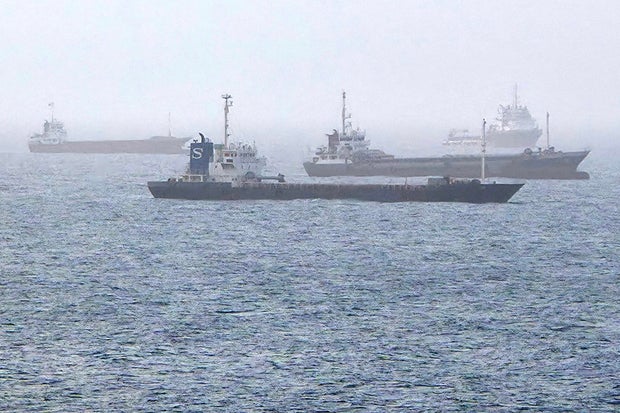
An Iranian official told CBS News' Margaret Brennan on Sunday that the talks between Iranian and Omani officials over the weekend were constructive, with discussions aimed at reopening the strait moving in a positive direction.
U.S. Ambassador to the United Nations Mike Waltz told "Face the Nation with Margaret Brennan" the pause was aimed at "giving diplomacy some space."
Waltz said the U.S. would gauge how things are going over the coming days, and he stressed that more U.S. military assets "are moving into the region," adding: "The regime should believe the president when he says they're locked and loaded."
Iran's Revolutionary Guard turns back 6 ships in Strait of Hormuz, state TV says
Iran's Revolutionary Guard's navy stopped six vessels trying to transit the Strait of Hormuz through routes not approved by Iranian authorities, state television reported on Monday.
"Last night, six vessels that attempted to transit through a route other than the designated one were stopped by the IRGC Navy with warning shots and turned back," a state television correspondent reported from the Gulf.
Earlier, state TV had said one was involved in an "incident," without elaborating.
On Saturday, the Guards said they'd stopped four vessels that were trying to transit through the southern part of the strait after firing warning shots.
Iran has effectively blockaded the Strait of Hormuz since the start of the Middle East war in late February.
400 U.S. service members flown out for treatment since Operation Epic Fury began
More than 400 U.S. service members have been flown out of the Middle East for various types of treatment since Operation Epic Fury began, a U.S. official told CBS News. However, most cases were not combat-related, the official said.
Operation Epic Fury, the military campaign carried out jointly by the U.S. and Israel against Iran, started Feb. 28.
Strait of Hormuz's status remains unchanged, Iranian official says
Iran's Foreign Ministry spokesperson, Esmail Baqaei, said on Sunday that the Strait of Hormuz's status remains unchanged, as Iranian and Omani officials continued talks to manage the safe transit of ships through the waterway that passes between both countries.
Baghaei said the talks had made progress. They took place after Tehran asserted that its interim deal with the U.S. allows it to manage shipping in the strait for now, and objected to U.S. efforts to support a route through the strait that passes close to Oman instead. The strait was considered an international waterway before the war.
The U.S. military on Saturday said its recently reimposed naval blockade against Iran continued, with a dozen commercial ships redirected, two disabled and two boarded. U.S. forces "remain highly vigilant, focused, lethal, and ready," it added.
Israeli Prime Minister Benjamin Netanyahu said Sunday on Fox News' "Sunday Morning Futures" that he supports Mr. Trump's pressure on Iran to end its nuclear program. During his upcoming visit to Washington, Netanyahu suggested he wouldn't share new intelligence with Mr. Trump and instead listen to "what he has in mind, because I think in many ways, it's his decision."
CBS/AP
Talks between Iran and Oman moving in positive direction, official says
Discussions between Iranian officials and their Omani counterparts over the last two days have been constructive, one Iranian official told CBS News on Sunday. Talks to reopen the Strait of Hormuz are also moving in a positive direction, the official said.
This diplomacy aims to reopen waterways around the Strait. It's directly linked to the U.S. halting strikes on Iran for the last two consecutive nights, although President Trump and Defense Secretary Pete Hegseth say the Strait is open already, and the U.S. controls it.
The U.S. Central Command paused bombings Friday and Saturday after 13 straight days of strikes. Tehran also paused bombings on Sunday.
U.S. Ambassador to the United Nations Mike Waltz told "Face the Nation with Margaret Brennan" on Sunday that the pause was aimed at "giving diplomacy some space."
"It's giving diplomacy a little bit of time. The president tried diplomacy last year, tried it this year. He is a president of peace. He is giving diplomacy a chance," said Waltz, who added that the U.S. will gauge how things are going in the coming days. "Make no mistake, assets, additional military assets, are moving into the region. The regime should believe the president when he says they're locked and loaded."
In a letter dated July 10, Trump gave formal notification to Congress that hostilities against Iran resumed on July 7.
In: