Steve Ladner,in Otfordand Tanya Gupta,South East

 Steve Ladner/BBC
A village in Kent is home to what is thought to be the world's largest scale model of the solar system and beyond, created to help people understand the enormity of space.
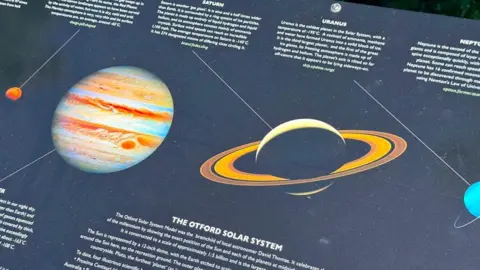
The model is spread across Otford, near Sevenoaks, with representations of the Sun and planets placed around the parish and stretching into nearby woodland.
Simon Featherstone, co-chair of the Otford Society, said the project was designed to allow visitors to "visualise the sheer vastness of our solar system".
Each planet is represented by a marker, with the Sun at the centre on the recreation ground and Pluto positioned about a mile away, reflecting distances at a precise scale.
 Steve Ladner/BBC
The idea was first proposed as a millennium project by local resident David Thomas, a retired teacher and amateur astronomer who wanted to create something that would inspire learning.
Featherstone told Secret Kent how Thomas carried out detailed calculations to ensure the planets were placed correctly.
"The idea was to put the planets in the exact positions that they were at the turn of the millennium. and so every planet had to be in exactly the right place in its orbit," he said.
The project involved consulting industry bodies to create materials that would last.
Thomas wrote to the Cement Federation asking for a mix "that would last a thousand years", while stainless steel was chosen for some elements after discussions with the Steel Federation.
The model has continued to evolve, with QR codes now allowing visitors to access videos and information about each planet using their phones.
Rod Shelton, president of the Otford Society, said support from Nasa helped bring the project to life.
"They were wonderful. They were so helpful," he said.
Shelton said Nasa allowed the team to use their material which mean they had access to "the world's finest pictures".
The scale of the model goes beyond the village, with representations of stars as far away as Los Angeles, Australia and New Zealand.
The closest star, Proxima Centauri, is marked at the Griffith Observatory in Los Angeles to reflect its true distance.
Despite its global links, organisers say the project remains rooted in the local community.
Shelton described Otford as "a very special village".
Related internet links