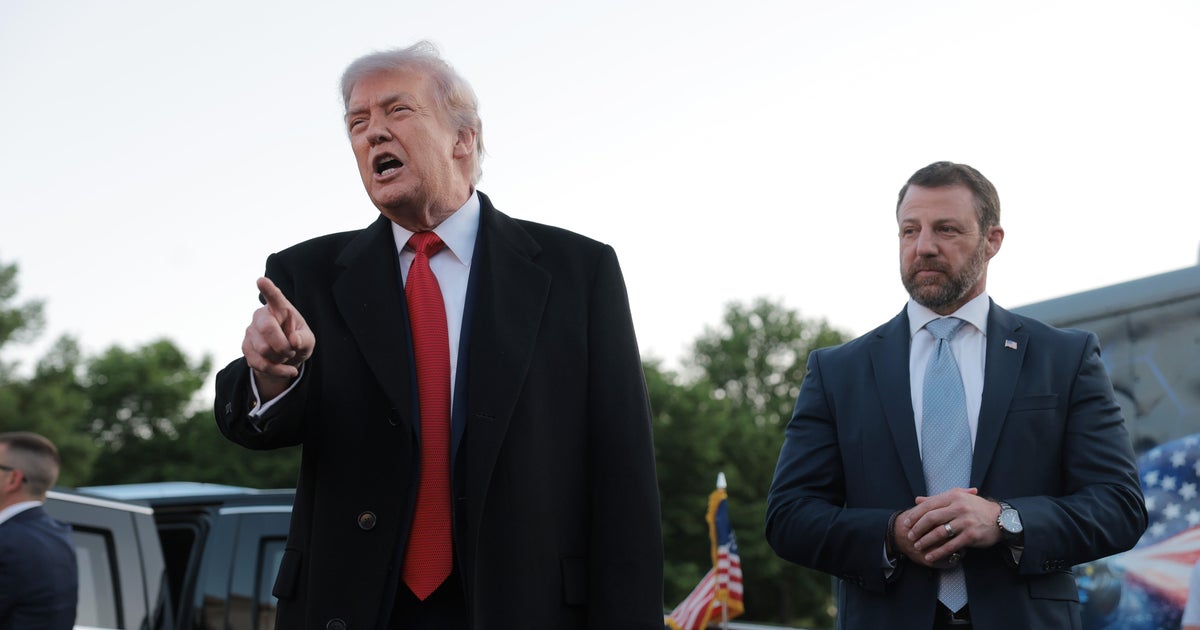
Washington — Homeland Security Secretary Markwayne Mullin on Friday continued to amplify President Trump's assertion that more than a quarter of a million non-citizens were registered to vote in four states, though the administration has yet to provide details of how it arrived at that figure.
In a news conference following Mr. Trump's address to the nation Thursday that focused on election security, Mullin said the alleged 250,000 non-citizens that it believes were registered to vote were in California, Pennsylvania, New Jersey and Nevada. Those four states have not complied with the Trump administration's demands to provide voter data to the federal government.
In 23 states that are working with the Trump administration and ran their voter records through an overhauled centralized federal database, Mullin said an additional 28,000 non-citizens were registered to vote.
But CBS News found that the claims from Mr. Trump and Mullin about the prevalence of non-citizens registering to vote could be exaggerated.
The estimate that there are 250,000 non-citizen registered voters across four states was based on an analysis of commercial databases, a White House official told reporters Thursday. That method is likely to lead to false positives, significantly overestimating the number of potential non-citizens on voter rolls, David Becker, executive director and founder of the Center for Election Innovation and Research, said during a CBS News special report Thursday.
"I guarantee you, that data includes a ton of people, maybe even a majority of people, who are absolutely eligible voters, and states would probably be breaking the law if they remove those voters from the rolls," Becker said.
The Center for Election Innovation and Research has found that allegations of non-citizens casting ballots or registering to vote typically "appear to arise from misunderstandings, mischaracterizations, or outright fabrications about complex voter data." When those claims are scrutinized and investigated, the number of alleged instances of non-citizens identified on voter rolls drops, the group said. Confirmed cases of non-citizens voting are exceedingly rare.
The president has long claimed without evidence that the 2020 election was "rigged" against him, though dozens of lawsuits seeking to reverse the outcomes in key battleground states were tossed out, and the Justice Department said at the time there was no evidence of widespread fraud. Still, amid the president's grievances about his loss to former President Joe Biden nearly six years ago, Mr. Trump has tried to expand the federal government's role in U.S. elections across his second term.
As part of those efforts, Mr. Trump has signed two executive orders that would tighten the rules for mail-in ballots and require documentary proof of citizenship to register to vote in federal elections, among other requirements, though they have been blocked by the courts. And the Justice Department is suing dozens of states to hand over their voter rolls. The president has also been pressuring Congress to pass the SAVE America Act, which would require Americans to show a photo ID to cast a ballot and present proof of citizenship in person to register to vote.
His election security-focused speech comes months before the November midterm elections, which will determine whether Republicans maintain their control of the House and Senate.
Here is what to know about the Trump administration's claims about non-citizen voting:
How does the 250,000 figure compare to the total number of registered voters?
Neither Mullin nor Mr. Trump said that the 250,000 non-citizens who are allegedly registered to vote in the four states actually cast ballots. The administration has also not made public its methodology for that estimate.
Still, that figure represents a small percentage of the total number of Americans who were registered to vote in the last two general elections.
A survey conducted by the U.S. Election Assistance Commission found that there were more than 209 million active registered voters for the 2020 contest, and more than 161 million people cast ballots that were counted.
For the 2024 general election, the Election Assistance Commission said there were more than 211 million active registered voters and more than 158 million ballots were cast and counted.
That means the 250,000 non-citizens that the Trump administration claims are registered to vote in Nevada, California, New Jersey and Pennsylvania are roughly 0.1% of all registered voters nationwide. The figure represents 0.6% of the nearly 40 million people who were registered to vote across the four states in question in 2024.
Federal law prohibits non-citizens from voting in federal elections, and no state allows non-citizens to vote in statewide contests, according to the Bipartisan Policy Center. Municipalities in just three states and the District of Columbia allow non-citizens to vote in local elections, like for school board.
How have the 4 states responded?
The Department of Homeland Security said Mullin sent letters to the secretaries of state for California, New Jersey, Nevada and Pennsylvania that called on them to "confirm their intentions to collaborate with DHS in order to ensure free, fair, and honest elections."
It claimed that "preliminary reviews" of the four states' records showed that there may be up to 190,832 non-citizens registered to vote in California, 35,152 in New Jersey, 15,903 in Nevada and 14,576 in Pennsylvania.
In response to the administration's claims, Pennsylvania Secretary of State Al Schmidt, a Republican, said the state's voter rolls are "properly maintained and updated." But he said the state will review any information provided by DHS to evaluate its claims.
"In Pennsylvania, every voter must take steps to verify their identity before they cast a ballot, including providing proper identification every time they register to vote, vote by mail, or vote at a new polling place," he said in a statement. "All evidence has shown that noncitizen voting is extremely rare across the country, including in Pennsylvania."
Nevada Secretary of State Francisco Aguilar, a Democrat, refuted the Trump administration's allegations that up to 15,903 non-citizens were registered to vote in the state.
"These numbers are wildly speculative at best and the Department of Homeland Security hasn't shared anything that backs it up," he said.
According to data provided to The New York Times, of Nevada's 2.1 million active registered voters, just 138 did not provide a state driver's license or Social Security number when they registered to vote. Those 138 voters, though, may have used another acceptable form of ID to register.
California Secretary of State Shirley Weber, a Democrat, said her state will review the federal government's methodology for identifying the purported 190,000 non-citizen voters to assess its claims. But she expressed skepticism.
"We welcome legitimate best practices that comply with state and federal law while protecting Californians' personal information," she said in a statement. "However, the information provided during the President's remarks and on the White House website, do not inspire any level of confidence in the methodology used or the conclusions reached."
What have other state audits found?
Several other states have conducted audits of their voter rolls in recent years and found some potential non-citizens were registered to vote, though such instances are extremely rare.
In Georgia, a citizenship audit done in 2024 found that just 20 of the state's 8.2 million registered voters were not citizens, according to Secretary of State Brad Raffensperger, a Republican. An additional 156 people required further investigation into their citizenship status.
Ohio also conducted a citizenship verification audit in 2024 and identified 597 non-citizens who had registered to vote, according to Secretary of State Frank LaRose. Of those, 138 people appeared to have cast ballots and were referred to the attorney general. The state said there were roughly 8.2 million registered voters in Ohio.
In Texas, a state with more than 18.6 million registered voters as of the 2024 presidential election, officials found 2,724 potential non-citizens who were registered to vote, according to its secretary of state.
Louisiana identified 390 non-citizens who had registered to vote after conducting an investigation into the citizenship status of people on its voter rolls. Secretary of State Nancy Landry said in September that of those 390 non-citizens, 79 voted in at least one election. As of July 1, there were more than 2.9 million people registered to vote in Louisiana, according to data from the state.
Iowa identified 277 confirmed non-citizens who were registered to vote and found 35 cast ballots that were counted in the 2024 general election. Five non-citizens tried to cast ballots but they were rejected. There were more than 2.1 million people registered to vote in Iowa as of July 2, according to data from the secretary of state.
What actions has the Trump administration taken?
Since Mr. Trump returned to the White House, his administration has mounted a multi-pronged push aimed at non-citizen voting. Claims that people who are not U.S. citizens are registered to cast ballots underpin the president's push for Congress to pass the SAVE America Act, a package of voting regulations.
The president signed an executive order last year that seeks to require documentary proof of citizenship to register to vote. But federal courts have prohibited the Trump administration from implementing that requirement, finding that the Constitution does not give the president any specific authority to regulate federal elections.
DHS also overhauled its Systematic Alien Verification for Entitlement, or SAVE, system, to effectively allow state and local officials to verify citizenship or immigration status of people trying to register to vote.
Several states have said they ran their voter records through the SAVE database to identify non-citizens on their voter rolls.
The modified SAVE system draws on records from the Social Security Administration and DHS, and was created in response to Mr. Trump's executive order. But a federal judge in Washington, D.C., found the Trump administration acted unlawfully when it created the centralized database, and said the clearinghouse had been used by some states to incorrectly remove U.S. citizens from their voter rolls.
The Justice Department has also sought to obtain full copies of voter registration lists from nearly all 50 states and Washington, D.C. More than a dozen states have cooperated with the Trump administration in its requests for their unredacted voter rolls, according to the Brennan Center for Justice.
Meanwhile, the Justice Department has filed lawsuits against 30 states and D.C. in an effort to force them to turn over the requested information, which includes voters' names, addresses, partial Social Security numbers and driver's license numbers.
Judges across the country have dismissed 16 of those lawsuits. One federal appeals court so far has said that the Justice Department is not entitled to the unredacted voter registration list from Michigan.
Jennifer Jacobs, Arden Farhi and Aaron Navarro contributed to this report.