Celebrating Worldwide Pinhole Photography Day
- Download
-
<iframe src="https://www.npr.org/player/embed/nx-s1-5795851/nx-s1-9744658" width="100%" height="290" frameborder="0" scrolling="no" title="NPR embedded audio player"> - Transcript

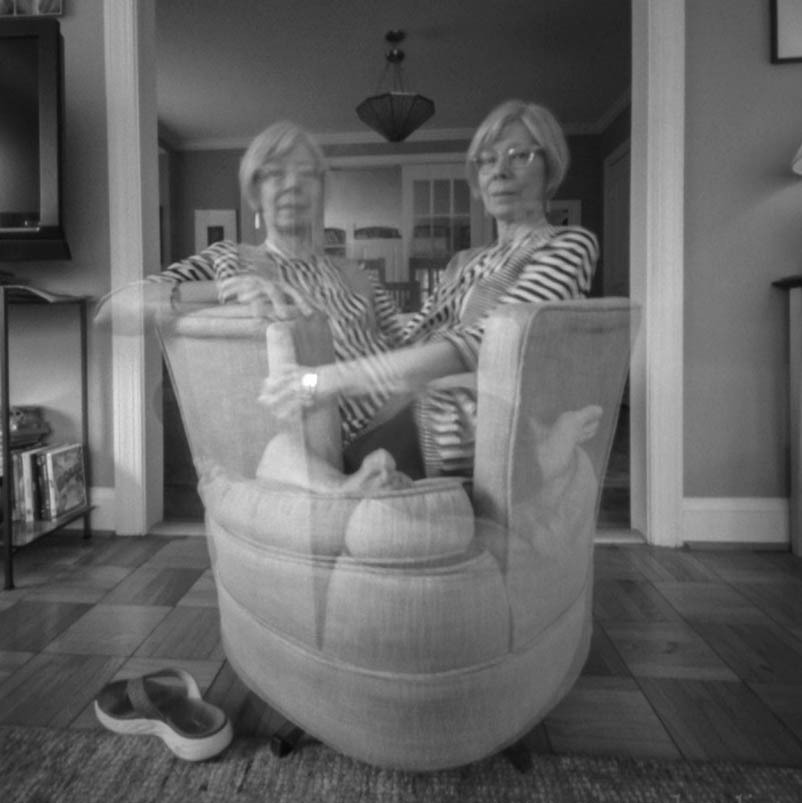
Nancy Breslin's double self-portrait taken on Worldwide Pinhole Photo Day 2019. 4 minute pinhole exposure. Nancy Breslin hide caption
toggle caption
Nancy Breslin
Pinhole photography is an analog technique that uses a small aperture — a "pinhole" — and a light proof container to capture wonderfully dreamy-looking images.
April 26 is Worldwide Pinhole Photography Day. To celebrate, NPR's Scott Simon spoke to Nancy Breslin, a fine art photographer specializing in pinhole photography.
Breslin brought a few pinhole cameras into the studio — one made of teak and brass, and one made of an old cookie tin. Breslin explained how the cookie tin camera works. First, you need a light tight container. Then you put a hole in it.
"Ideally you want it to be pinhole sized, like putting in a sewing needle, maybe half a millimeter or so." Then, put in a piece of photographic paper. "When enough light hits, you have an image," Breslin explained.
Capturing an image can take anywhere from a few minutes to a few hours, depending on how much light is being let in through the camera's pinhole. The resulting images are surreal and a little spooky.
Breslin's main series is called "Squaremeals: A Pinhole Diary of Eating Out." She takes her pinhole camera out to lunch with friends. Then she takes one image during the meal.

A photo from Nancy Breslin's "Squaremeals: A Pinhole Diary of Eating Out" series. Nancy Breslin hide caption
toggle caption
Nancy Breslin
Breslin describes an image from this series. Because the exposure was long, the still objects, like a waterglass, are sharp and in focus. But the moving objects, like Breslin and her dining companion, are blurry. "It becomes very ghostlike. Is that not the way our memories work? You know, our memories aren't tight. It's more like the impression," Breslin said.
If you want to participate in this year's Worldwide Pinhole Photography Day, you can make your own pinhole camera using household objects.
Make your own pinhole camera:
- Find a light proof container. A cylindrical oatmeal container works well.
- Line the inside black, either with black paper or black matte paint. This prevents light from bouncing around the container.
- Poke a small hole directly into your container.
- Attach a "shutter" that covers the hole, but can be easily removed and replaced to take your picture.
- Load photo sensitive material, like photopaper, inside of the container on the opposite side of your lens.
- Take your photo! Point the hole toward the scene you want to capture and open your "shutter" to allow the light to enter the hole and deposit the image onto your photosensitive material. Remember that darker areas will require the shutter to be open longer, and brighter areas can have a lower exposure time.
- Develop your images. You can send your film to a photography lab, or, take to a local darkroom. Enjoy your pinhole masterpiece!
Ariel Plotnick edited this story.