With an acting defence minister in place and a new commander-in-chief in charge of the military, Ukraine's recent political crisis is over, right?
Not so fast.
The political fallout from President Volodymyr Zelensky's 15 July decision not to re-appoint Mykhailo Fedorov as defence minister, as part of a cabinet reshuffle, continues to reverberate about Kyiv and beyond, even as air raid sirens wail and Russian drones and missiles are intercepted overhead.
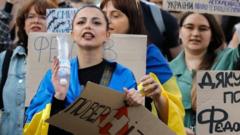
Fedorov's mostly young supporters are still mounting daily street protests, demanding that Zelensky reinstate the popular young innovator widely credited with driving much of Ukraine's recent technological innovation.
On Thursday, Fedorov said he had rejected Zelensky's offers of alternative posts in government, saying there were only three positions worth having to influence the course of the war: minister of defence, commander-in-chief of the military or president of Ukraine.
"If you don't have a ministry under you, you don't have a budget," ex-deputy defence minister Alina Frolova said, "and you don't actually have the authority to do something."
Fedorov's reference to the presidency did not go unnoticed. Was this the first public sign that the ousted minister sees himself as a rival to Zelensky?
One former defence official suggested he became a real candidate for the presidency the moment he was dismissed.
But with the country at war and no elections scheduled – Ukraine's constitution still prevents them in wartime – how useful is it to put your head above the political parapet so far in advance?
"He's being childish," one opposition MP told me, on condition that he remained anonymous.
"He's looking to further his political career, which I think is just stupid in the circumstances where we are."
The president's supporters say Zelensky has gone to great lengths to resolve the crisis, especially over the question of who to replace the unpopular commander-in-chief, Oleksandr Syrskyi.
Eventually he decided on Maj Gen Mykhailo Drapatyi, 43, a highly respected former commander of Ukraine's land forces.
"He consulted pretty much every significant figure in the Ukrainian army," former government adviser Yuriy Sak told the BBC earlier this week.
"So the decision that he has taken now is very well informed, and I support it because General Drapatyi is a young, battle-proven, modern general who will take our defences to a new level, hopefully."
But while Drapatyi's appointment has been generally welcomed, it only represents a partial fix by a president scrambling to repair the damage caused by his removal of Fedorov.
Ironically, for a president whose youth and apparent dynamism propelled him to power in 2019, Zelensky seems to have misjudged the mood of young Ukrainians, eager for their leaders – political and military – to represent their values and aspirations.
"It's quite natural that people want to see someone who is a warrior against corruption, who is very modern, who is young," Oleksandr Merezhko, an MP from Zelensky's Servant of the People party.
"People want to see something like that in politics, which they consider to be dirty and full of hypocrisy. They need heroes."
But Merezhko agrees that Fedorov's ambitions and almost mythic, popular status may have brought about his downfall, especially for a president with a track record of sidelining those he sees as potential rivals.
"Don't outshine your master," Merezhko says, quoting from Robert Greene's 1998 self-help book, The 48 Laws of Power.
Most analysts agree that last week's reshuffle had one overarching purpose: to cut Fedorov down to size. But Zelensky's strategy appears to have backfired.
"His removal has led to the opposite result," Merezhko says. "His rating soared. Just soared."
Few doubt Fedorov's commitment, imagination and drive, but some question whether his outsized reputation is fully justified.
They point out that he inherited a situation in which Ukraine had already successfully built up its medium- and long-range strike capabilities, something over which the defence minister has little day-to-day influence.
"The energy and clarity he brought to the job was impressive and he showed immense personal courage," a former European defence official said. "But the thing that will carry on regardless is the innovation culture. It's 2,000 companies, not a single individual."
One opposition MP, who asked not to be identified, put it more bluntly.
"Ninety-nine per cent of these young people on the street have no clue how the ministry of defence is operating, how the general staff is operating," he said.
"They think Fedorov is good because he wants to fight with drones and Syrskyi was bad because he was looking for people to fight. It's a dramatic simplification which is totally wrong."
But understandable, perhaps, in a country exhausted by 12 years of war with Russia. Who would not want to believe that drones and robots can do the job, rather than a member of your own family, roughly conscripted on the streets of your own hometown?
Everyone agrees that Ukraine needs to put this politically toxic episode behind it before summer gives way to autumn and the country braces itself for another Russian assault on its energy grid.
"We need to prepare for how we will get through the winter," Zelensky said on the Telegram messaging app on Thursday.
Politicians and experts interviewed for this piece mostly agree that while the political damage of this episode continues to undermine President Zelensky's authority and reputation, Ukraine is unlikely to experience significant setbacks on the battlefield.
What Zelensky calls his "long-range sanctions" campaign against Russia is in full swing, causing mounting damage to the Russian economy.
Ukraine's long front lines, meanwhile, remain largely static, thanks to a 15-30km (9-18-mile) wide "kill zone" where anything or anyone who moves is observed and attacked by drones.
As a young, still relatively immature democracy, Ukraine's institutions have been put under colossal strain by Russia's full-scale invasion. But, many argue, the country remains resilient and resourceful.
"The secret of Ukraine's success is that we are much stronger horizontally than vertically," opposition MP Andrii Osadchuk told me.
"I hope the damage will be minimal."