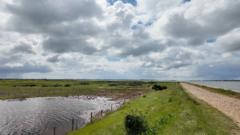
Areas of salt marsh and marsh grazing like Farlington are incredibly important and rare habitat in the south of England.
Not only does it provide a unique home for wildlife but coastal fringes act as both a natural flood defence and a carbon sink.
But with rising sea levels due to climate change such sites are getting squeezed out.
Development and hard infrastructure - in Farlington's case, the A27 - means there is nowhere for the marshes to retreat inland. In the future, unless action is taken, there is a real risk they will be lost altogether.
But finding areas of land to recreate lost salt marsh on a large scale is a near impossible task on an already crowded coast line.
Dr Stefanie Carter, coastal eco systems scientist at the UK Centre for Ecology and Hydrology, described it as a "declining habitat".
"It is possible to create salt marshes and restore some of the marsh we've lost but it probably won't be possible to do this at the scale."
"It's similar to peatland where in the past they've been regarded as wastelands. In the past they were dried out for agriculture and now they're realising peatlands are really important."
"And it's the same for saltmarshes. We're realising how important they are so we're trying to prioritise restoring them."